News & Trends
From plough to algorithm – 10,000 years of progress

Since the moment humans invented the plough, we have tried to understand the world and improve it. Every invention reflects that ambition. Today, we meet is most powerful mirror yet: artificial intelligence.
Securing food production.

Creating mobility.

Knowledge spreads.

In the 1950s Alan Turing asks, “Can machines think?” Intelligence becomes a task, not only a gift. In the 1980s data connects the world. Knowledge flows without borders, and so do misunderstandings. In 1997 a computer defeats the world chess champion and proves that strategy can work without awareness.

2022/2023 language becomes an interface. AI writes, and we begin to think in new ways. In the future AI systems learn, humans shape. The question endures: who leads whom?

The plough made us settle, the wheel made us mobile, the steam-engine-powered industry, and the computer opened the Information age. Each invention pushed the boundary of what we can achieve and reshaped how we see ourselves.
Now comes artificial intelligence, a technology that does more than amplify strength or process patterns, draws conclusions, and formulates answers. In doing so, it steps into a role once reserved for us humans.
Why now?
Its rise at this very moment is no coincidence. Several developments lock together like gears. Computing power has surged. Specialized chips and global cloud systems supply the capacity modern AI models need. At the same time, the world has become one vast data source. Science, business, and culture are digitized, analysed and turned into usable assets. New model architectures and Training methods have unlocked a leap forward: AI does not only recognize, it creates, producing language, images, and code. The result is a technology as fundamental as electricity or the internet, a quiet Transformation reaching into every part of life.
Powerful, not wise
This marks a new chapter. Earlier Technologies replaced or accelerated physical labour. AI
automates something we long considered uniquely human: thinking, deciding, creating. Knowledge work becomes reproducible and far cheaper. Entire professions shift, and the division of labour must be reconsidered. What, then, can AI truly do, and where are ist limits? It excels at pattern recognition, tireless analysis, and consistent execution. But it does not understand its own actions. It sees correlations, not meaning, and can produce answers that sound right while being wrong. It is also bound to its physical base: chips, energy, water, data. AI can propose options and run processes, but responsibility stays with people – or it disappears.
0.5l
of water is used by a single ChatGPT query.
35%
of all online videos will be generated by AI by 2030.
90%
of all online texts will be influenced by AI by 2026.
56%
is the increase of AI-related privacy and security incidents in 2024.
61%
of Generation Z find it comfortable to talk to ChatGPT about things they would not tell people.
2tril.
is the market volume
for AI expected in 2030 compared to USD 140 billion in 2025.
37%
of Germans feel confident using AI.
7%
of all authors have agreed to
their work being used to train AI.
Progress and concern
In research, discussions already point toward superintelligence – systems that surpass humans across cognitive tasks. Some see the next stage of knowledge in this vision. Others, including OpenAI’s Sam Altman, warn of the consequences of systems that become too capable. What is clear: progress and concern have never been closer together. If AI helps to shape the world, we need guardrails. Systems must remain transparent, people must stay in control, and environmental costs must be visible. Most of all, it is About collaboration: AI should expand human capability, not replace it. It should support, not
diminish.
The new core skill
The most important skill in the years ahead may not be coding but asking the right questions – framing problems in ways that allow AI to respond usefully. Technology can offer countless options, but purpose, direction, and responsibility remain human tasks.
What remains human?
AI can detect patterns, but not meaning. We sense what data cannot capture: wonder, doubt, empathy. That may be our deepest form of intelligence.
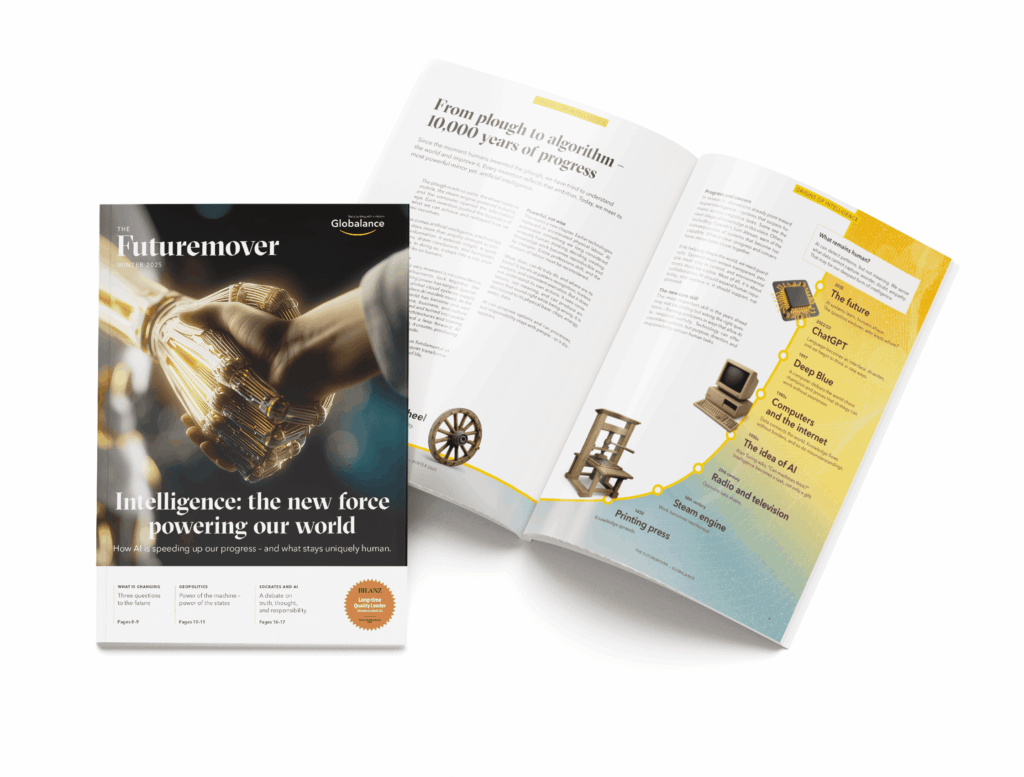
Discover the entire issue
Read more articles from our current issue: ‘Intelligence: the new force powering our world’.
Be part of the solution and stay informed with the Futuremover.
Subscribe now and shape the future!
Magazin abonnieren EN
"*" indicates required fields


