News & Trends
Power of the machine – power of the states

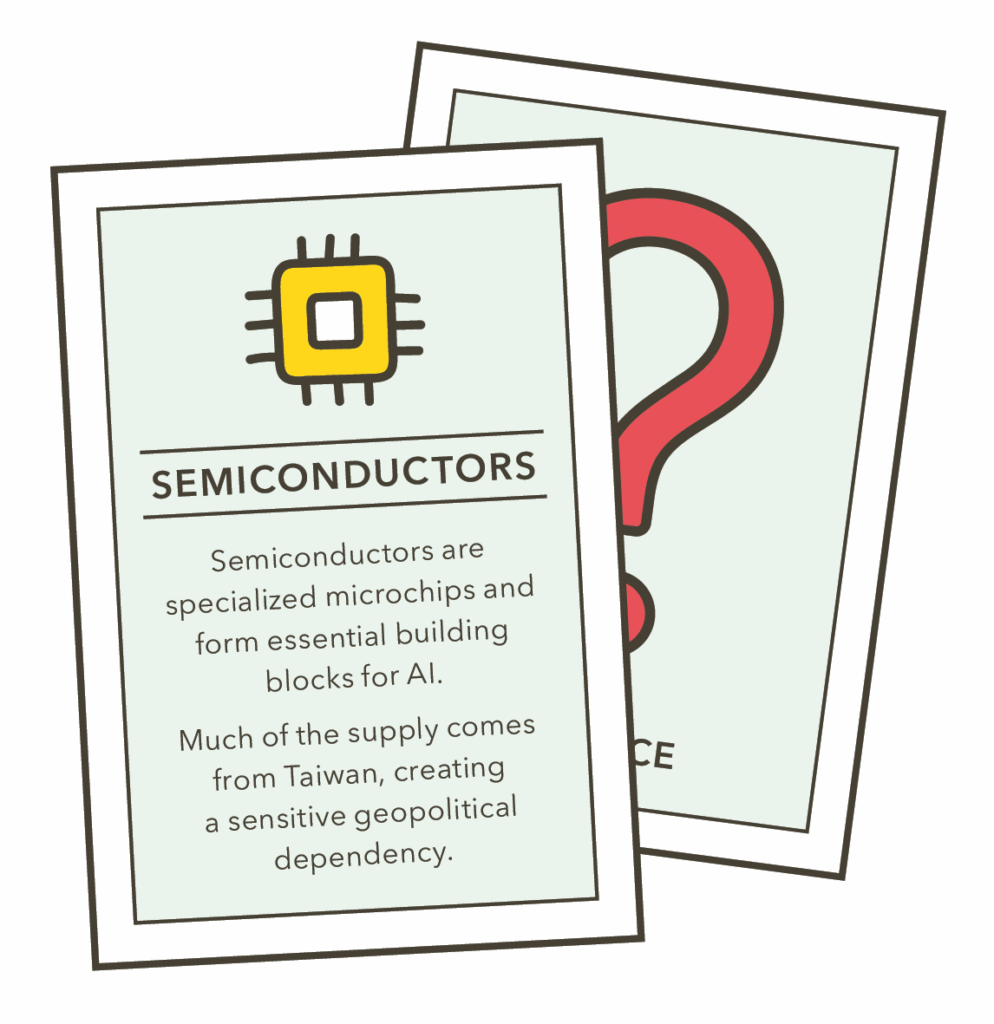
In the past, rockets shaped global influence. Today, AI chips and data centres determine geopolitical weight. With artificial intelligence, digital infrastructure becomes a golden key in the world order.
Whoever controls data, data centres, and AI chips gains influence. Unlike the early internet, which was built for open exchange, AI can be shaped and governed more tightly at the national level. “AI is a cross-cutting Technology with enormous leverage,” says Myriam Dunn Cavelty, security policy expert at ETH Zurich. “It reaches into the economy, security, and international relations – and will help define the future.”
United States: Innovation as a strategic asset
The US relies on the innovative power of ist tech giants. Microsoft, Google, and OpenAI have become a kind of national capital: they attract global talent, operate the largest Cloud infrastructures, and build the most capable AI models. “At the moment, the US clearly holds the strongest position,” says Dunn Cavelty. Billions in Defense Department investments – from autonomous drones to cyber defence to AI systems that support military decision-making – reinforce this lead. The strength lies in the interplay between government and industry; the weakness is the reliance on a handful of dominant firms.
China: Control as a strategy
Beijing is pursuing a master plan: by 2030, China aims to be a global leader in artificial intelligence. With central planning, massive data pools, and deep integration of society, business, and the military, the country is pushing its AI expansion. AI optimizes traffic flows, powers facial recognition, and is used in defencde projects.
The strengths are speed, coordination, and data volume. But there is an Achilles heel: “China remains heavily dependent on Western semiconductor technology,” Dunn Cavelty notes. Global trust is another challenge, as surveillance and censorship weaken China’s credibility abroad. Start-ups like DeepSeek have drawn international attention, but Dunn
Cavelty emphasizes that isolated breakthroughs are not enough. What matters is the entire ecosystem of infrastructure, talent, and capital.
«Technology is never neutral. It is designed, shaped, and influenced by People and politics.»
Europe: Rules instead of resources
Europe is leaning on regulation. With the AI Act, the EU aims to set standards, much like it did with data protection. “Without trust, People will not embrace AI over the long term,” says Dunn Cavelty. But she warns that Regulation alone will not close the gap. Europe has no tech giants on the scale of Amazon or Microsoft and little semiconductor production, which keeps the continent dependent on imports.
The challenge is recognized, though. Initiatives like Gaia-X for European data and Cloud infrastructure and new semiconductor Programmes aim to strengthen technological independence. Whether Europe can build a real counterweight to the US and China will depend on speed and political commitment.
Tech companies: New centres of power
The role of companies has shifted. Nvidia supplies the H100 chips that act as the oxygen of the AI industry, Microsoft secures major stakes in start-ups, and Google sets standards through its cloud services. “Right now, you cannot advance in AI without big tech,” says Dunn Cavelty. At the same time, the CEOs of these firms appear more political and take part in public debates. “Oil companies once held power as well, but it was not this close to our daily life.”
Between promise and risk
Trade restrictions on China and US Export controls on AI chips show how technology already serves as a geopolitical tool. At the same time, the risk of AI-driven cyberattacks and disinformation is rising. Early examples from the war in Ukraine highlight how real this threat has become.
For Dunn Cavelty, AI is a force multiplier. It amplifies what already exists. On the positive side, it enables new medical treatments, advances in climate research, and more efficient energy grids. On the negative side, it creates new dependencies on energy and raw materials and fuels polarization. Whether AI becomes socially viable depends on whether people understand the goals it follows and how it makes decisions.
Talents in the global race
Beyond infrastructure, people are decisive. Sought-after AI researchers move between universities, start-ups, and defence projects. “Talent is the scarcest resource of all,” Dunn Cavelty notes. Switzerland benefits from ETH and top-tier research, but it loses many international graduates to other countries because strict visa rules make it hard to start a Career and venture capital for start-ups is limited. Switzerland may be small, but it can have real impact by creating space for dialogue and by retaining talent.
Artificial intelligence has become a geopolitical power factor – those who control chips shape the future.

Dr. Myriam Dunn Cavelty is the Deputy Head of Research and Teaching at the Center for Security Studies at ETH Zurich. Her work examines how digital technologies shape political behaviour and societal values.
Discover the entire issue
Read more articles from our current issue: ‘Intelligence: the new force powering our world’.
Be part of the solution and stay informed with the Futuremover.
Subscribe now and shape the future!
Magazin abonnieren EN
"*" indicates required fields


