News & Trends
Three questions to the future

Who determines progress? What remains of our creativity? And does AI help solve humanity’s biggest problems? Future strategist Pero Mićić dares to look ahead.
Prof. Dr. Pero Mićić is a future strategist, author, and entrepreneur. For 34 years, he has focused on how people and organizations can shape the future instead of simply reacting to it.
Can AI help us solve humanity’s major challenges – or will it actually exacerbate them?
Both will happen. AI will certainly create new challenges. Even today, we can no longer trust videos. Fakes are practically indistinguishable from real content. Criminals can cause much more damage with minimal effort. Aggressive regimes can oppress their citizens even more effectively. And they can sow even more discord in other countries, as we have seen from Russia for decades. Yes, malicious actors will use AI for crime, disinformation, and terrorism. But there are always far more people with good intentions.
At the same time, AI is our greatest opportunity to save the truth. For example, platform X, formerly Twitter, has made it possible to ask its AI Grok about the extent to which every postand every comment is true and correct. Those who lie and spread disinformation are more easily exposed.
New possibilities – new system
The power of AI and robotics will exceed our imagination. AI that improves and developsitself will lead to an explosion of intelligence. AI will make it possible to solve previously incomprehensible and unsolvable problems. We will live healthier and longer lives, enjoy a higher quality of life, and be able to lead more fulfilling lives overall.
The real challenge will be to manage the transition period well. We will have to change our economic system. Today, over 90 percent of people earn their income as employees. However, this will no longer work because 60 to 80percent of today’s human tasks will be automated in the coming years.
We need an economic system in which people can primarily live off their ownership of productive assets. In today’s world, that mainly means stakes in AI-ready companies. Until thisis achieved, transfer payments will have to be made to the non-wealthy. This is best done in the form of a negative income tax.
What are deepfakes?
Deepfakes are images, videos, or voices generated or manipulated using AI that appear deceptively real – but are fake. In 2023 alone, over half a million deepfake videos and audio recordings were discovered worldwide – around ten times more than in the previous year. They highlight how difficult it is to distinguish truth from fiction.

What will become of our creativity and freedom of choice in a world full of AI?
We are in control. AI makes us more productive, more creative, and more confident in our decisions. The wording matters: AI makes us. Those who understand how to use it can create more value and reach their goals faster. Even today, AI already contributes to new medicines, materials, and technologies. It will lift our problem-solving abilities to levels we have not seen before.
Whether people become less intelligent or less creative because of AI depends on their attitude toward their work. Those without goals who mainly seek comfort will hand over as many tasks as possible to AI to avoid effort. Our brain behaves much like our muscles. If we stop using it, it weakens. People without ambition will indeed lose skills when they rely heavily on AI.
What we make of AI
Those who pursue their mission with passion, enjoy their work, and want to create better solutions again and again will become smarter and more creative with AI. Because AI produces many results, processing them requires real mental effort. It is top-level thinking. AI is like a bicycle or a car for the mind. It boosts intelligence, creativity, and knowledge. It brings us to a higher level.
33%
productivity gain delivered by generative AI per hour.
7%
of all authors have agreed to
their work being used to train AI.
78%
of companies worldwide already use AI in at least one business function.
Who controls the future – people, machines, or markets?
Humans shape markets through supply and demand. The question often posed is whether the future belongs to people or machines. The answer is straightforward: people will continue to use machines to achieve their goals. These machines will either be virtual AI systems or embodied AI in the form of robots. The fear that AI might become autonomous and harm humanity is understandable. It is difficult to control something more intelligent than the people who oversee it, especially if it can improve itself.
Still, the likelihood of AI causing major harm in the near future is far lower than the likelihood that it will raise our quality of life. In the long run, we will live in greater abundance. AI and robots will sharply reduce labour costs, which will lower the cost and price of goods and services. As long as there is sufficient competition, we will not end up in a world where a handful of tech companies dominate and control society.
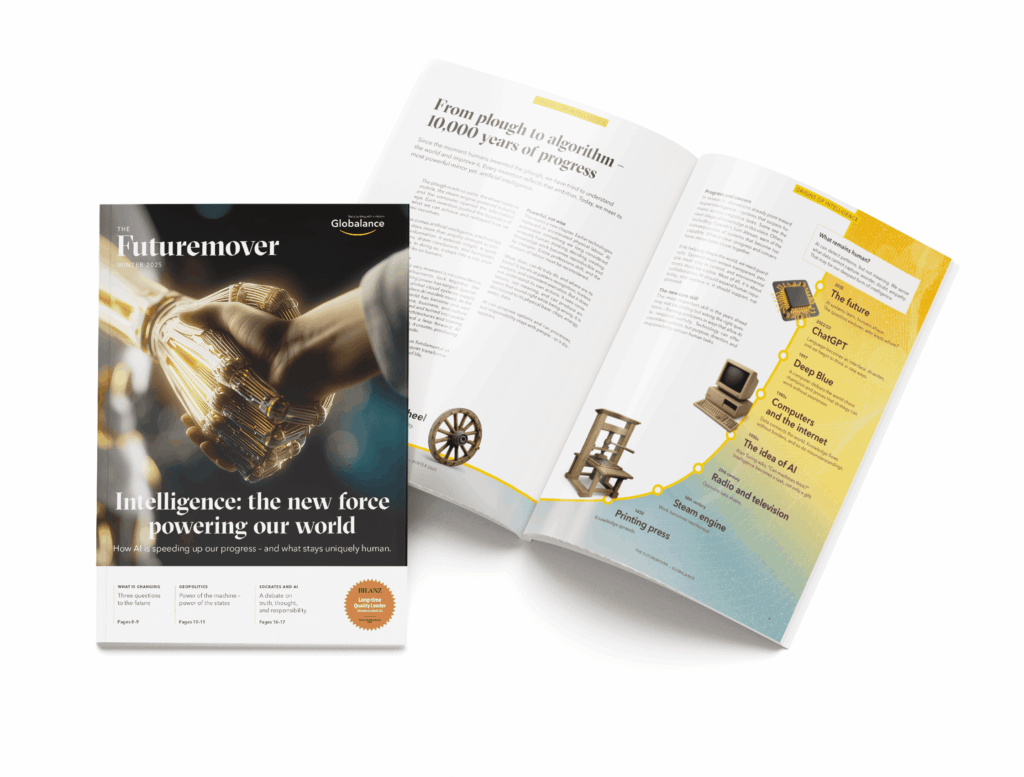
Discover the entire issue
Read more articles from our current issue: ‘Intelligence: the new force powering our world’.
Be part of the solution and stay informed with the Futuremover.
Subscribe now and shape the future!
Magazin abonnieren EN
"*" indicates required fields


