News & Trends
There’s a price to pay for ignorance

With his Swiss start-up Vertify.Earth, Michael Anthony uses artificial intelligence to make changes in nature visible and measurable. In this interview, he talks about the opportunities and limitations of AI — and explains how it can create a net-positive impact on the environment and biodiversity.
The elevator pitch: What does Vertify.Earth do – and who are your clients?
Vertify.Earth turns satellite data into evidence for nature. We help investors, companies, and public-sector institutions understand how their activities affect land, water, and biodiversity through measurable, verifiable, site-specific data.
Our clients include investors and companies that integrate environmental stewardship and long-term impact on nature and society into their decisions, development agencies building environmental baselines, and NGOs focused on regeneration and accountability. In short: we make nature visible, measurable, and accountable.
What was the “Aha moment” that led you to create this platform – and why now?
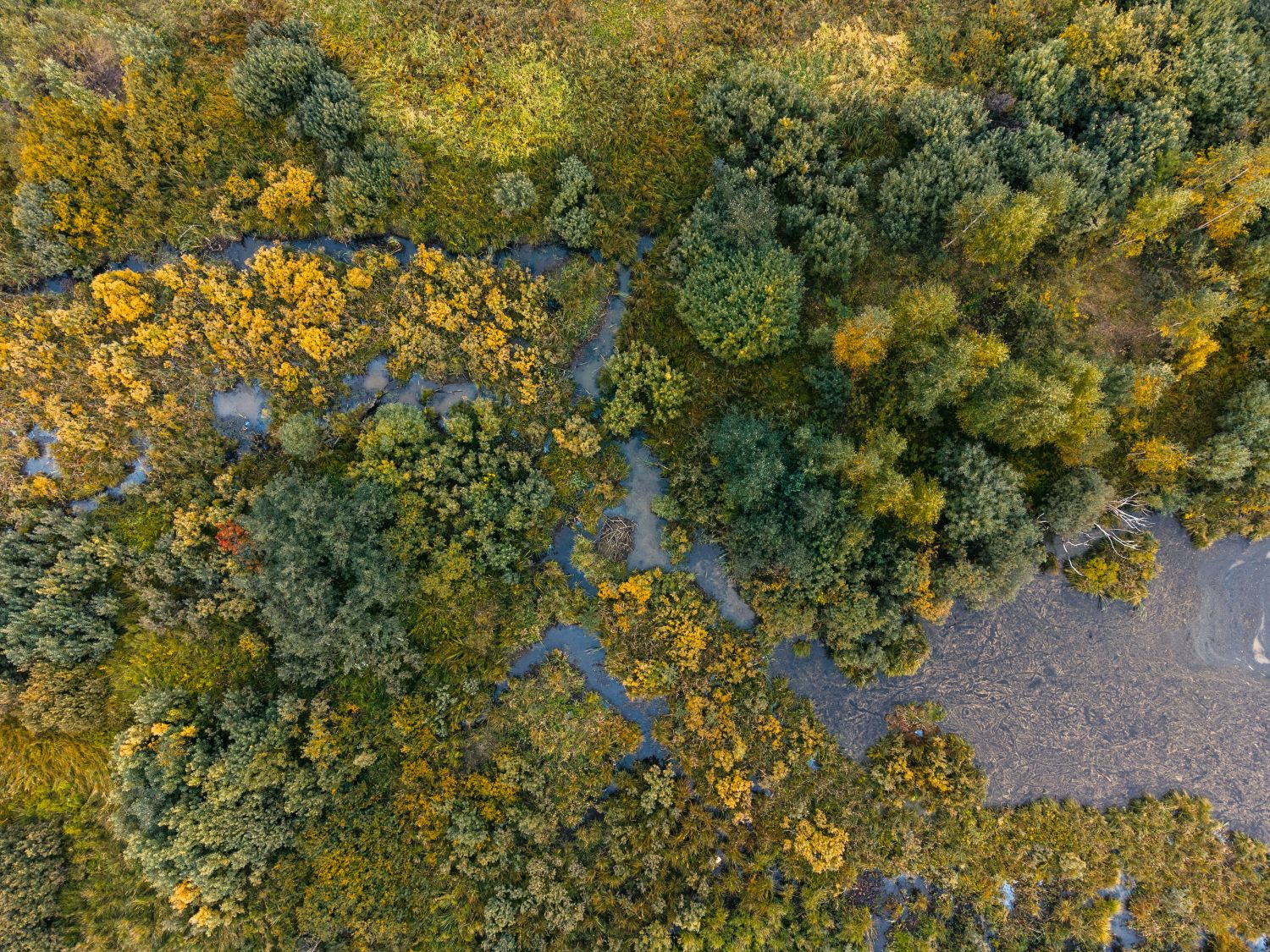
When I worked in climate insurance, I saw how hard it was to verify what was really happening on the ground – whether forests were recovering or fields were still flooded. While there were many sophisticated actuarial models that insurers used for pricing – they too often rested on questionable data because insurance claims were settled on general observations and a few random ground checks rather than spatial information. That is when I realised that satellite data gives us a broader view that can also investigate dependencies like those that lead to a natural disaster or the impact of any industrial action on nature.
Where do you see the greatest potential for AI in protecting biodiversity?
AI helps us see patterns that humans would miss – subtle shifts in forest structure, soil moisture, or water turbidity across vast landscapes. Its greatest potential lies in early warning systems: detecting ecosystem stress before it’s visible, or predicting where degradation will spread next.
But these results are only achieved when automation processes are built upon and governed by deep human expertise – and shaped by communities, like farmers in the case of agriculture, as well as by experts who define the right standards, values, and direction.
AI by itself does not know where to start or when to bring in human insight from the ground. It can enhance existing analytical processes, but it is not good at inventing new ones.
Is there a project or technology at Vertify.Earth where AI enabled something that was previously unthinkable?
We once looked into cotton harvesting in Xinjiang, where importers were accused of using forced labour from the Uyghur minority. The Chinese government said most cotton was machine-harvested, so there was no labour involved – let alone forced labor. Using satellite images and machine-learning, we analysed how the fields were actually harvested – by hand or by machine. Most were hand-picked, right next to labour camps – clearly contradicting the official story.
AI itself consumes resources and burdens ecosystems. How does Vertify.Earth deal with this paradox?
That’s a fair question. Every computation has a footprint – but so does ignorance. We also try to build on existing AI architectures rather than constantly training new ones. We’re too small to reinvent the wheel – and we don’t need to.
Not every task requires a large language model; many analytical jobs in our field can be done by simple, well-trained machine-learning algorithms that use only a fraction of the computing power.
Instead of chasing ever-larger models, we focus on refining existing intelligence and making it more context-aware. By doing so, we achieve a clear positive balance: using digital intelligence to reduce ecological uncertainty, not to add to it.
What was the biggest surprise or most unexpected result AI has produced for you?
AI often surprises us – sometimes also by being wrong! In one project on urban land use, a model showed a big rise in sealed surfaces, which turned out to be brown crop fields mistaken for rooftops. But in another project in Goa and the Himalayas, we trained deep-learning models on local satellite and LiDAR data to estimate forest biomass. The results were far more accurate than NASA’s global models. That was a clear lesson: global datasets are powerful, but without local training and context, they can mislead. In the end, context — and human interpretation — still matter most.
Which start-ups in the field of environmental protection and biodiversity do you find most exciting?
In Europe, I’m particularly inspired by Constellr from Germany, which uses thermal satellites to detect water stress in crops and ecosystems. Also, Svarmi in Switzerland combines satellite data with drones to look deeper where satellites alone can’t reach.
And I find great promise in the use of acoustic sensing and eDNA analysis – from companies like Synature and DNAir in Zurich, as well as NatureMetrics in the UK. Together, they represent a future where nature monitoring becomes multisensory.

Global datasets are powerful, but without local training and context, they can mislead. In the end, context — and human interpretation — still matter most.
What are you most proud of in relation to Vertify.Earth?
I’m proud that our data has changed real decisions on the ground. In the Himalayas, we helped an impact investor measure its portfolio using IRIS+ biodiversity indicators. By combining satellite, sensor, and socio-economic data, we showed which projects created genuine nature-positive outcomes. That evidence helped the investor work with its portfolio companies to improve their practices — and ultimately shift capital toward activities with stronger ecological impact.
What have been your key learnings – what would you do differently today?
We learned that context beats technology. In the early days, we focused too much on the algorithms — now we focus on understanding the landscape, the seasonality, and the people behind the data. AI is powerful, but it struggles with context — and that’s where human insight matters most.
A simple example from remote sensing: when we see flooded farm plots in South Asia, the model might flag them as a disaster. But by understanding the crop type and the time of year, we know it’s just irrigated rice. Partnerships and local knowledge matter more than code. If I could start again, I’d spend less time training models and more time listening.
If Vertify.Earth could have one superpower, what would it be – and why?
We measure the Earth with satellites, so of course there are limits. The most obvious one is technical — clouds. Many sensors can’t see through them, and even radar has its blind spots. If we could have a real superpower, it would be to see clearly through those clouds. But the other kind of superpower is human — collaboration. Working with others who measure and audit their own nature impact lets us see farther than technology alone ever could.
Looking into the crystal ball: Where will AI stand in 2035 in relation to climate and environmental protection?
By 2035, AI will be part of the everyday infrastructure of environmental governance – from automatic habitat alerts to predictive land-use and restoration models.
Global “foundational models,” like the one Google recently released, will form the backbone of this system.
But the real breakthroughs will come from how we adapt those models to local realities. Every ecosystem is different, and only by combining global AI infrastructure with open, locally sourced data can we make these models truly useful.
And here, we need to trust human – or in this case, local – voices. AI is very confident, but it doesn’t ask questions when it doesn’t know the answers. We need a bit more humility, especially in light of indigenous knowledge and the complexities of nature.
Remaining critical – and working consciously on our values – is something only humans can do. By 2035, we will (hopefully) have the right guardrails in place to remind us of that.
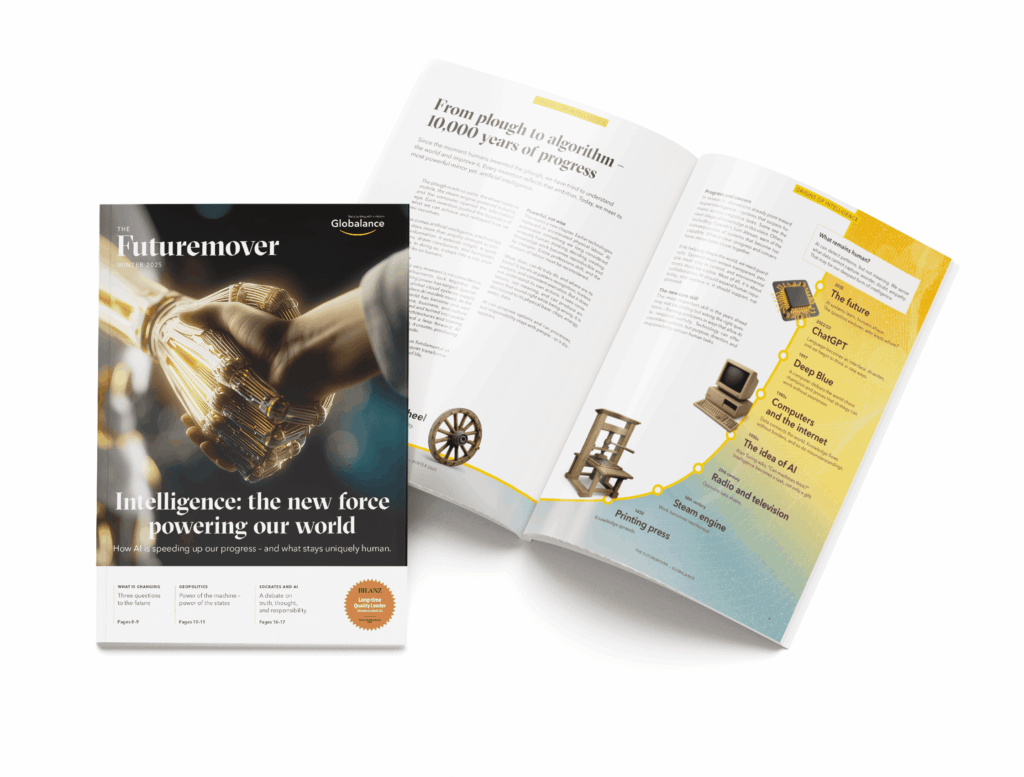
Discover the entire issue
Read more articles from our current issue: ‘Intelligence: the new force powering our world’.
Be part of the solution and stay informed with the Futuremover.
Subscribe now and shape the future!
Magazin abonnieren EN
"*" indicates required fields


