News & Trends
Where AI protects nature – and endangers it

By 2025, CO2 emissions have risen to record levels: fossil fuels, global growth, and the energy hunger of AI have driven them up. But could artificial intelligence turn out to be the lifeline in the fight against climate change?
From training massive models to generating videos from a single prompt, AI consumes resources like no technology before it – and consumption is only increasing. At the same time, AI opens unprecedented opportunities to protect the environment and fight climate change. Innovative start-ups are working to make the technology greener and more efficient. We highlight some of their solutions.
Protecting the climate
Global warming is accelerating, yet we continue to consume more energy than the planet can sustainably provide. To improve the global carbon balance at scale, AI manages power grids – seamlessly integrating renewable energy sources. Intelligent automation further reduces energy consumption in industry and buildings.
Start-up: Techifab, Germany
To ensure AI’s potential doesn’t come at the environment’s expense, Techifab develops chips inspired by artificial neurons. These chips process and store data faster and far more efficiently – reducing energy consumption by up to 90 %.
Preserving biodiversity
Fragile habitats and a changing climate are putting ecosystems at risk. AI can detect patterns humans often miss – subtle shifts in forest structure, soil moisture, or water quality across vast landscapes. It flags ecosystem stress long before it becomes visible. Through automated monitoring, AI has already helped discover hundreds of previously unknown animal and plant species.
Start-up: Vertify.Earth, Switzerland
Leveraging satellite data and AI-driven analysis, Vertify.Earth makes the environmental impact of human activity visible.

By combining AI with ecological expertise and local knowledge, this Swiss start-up helps companies, governments, and NGOs monitor and enhance their nature and climate projects.
Every calculation has a footprint – but ignorance has a cost too.
Michael Anthony, Founder of Vertify.Earth
Securing mobility
Whether taxis, transport vehicles, or delivery fleets, autonomous electric systems are already proving successful in California and China. Intelligent algorithms optimize routes, traffic lights and public transport in real time – reducing congestion and emissions by up to 30 %.
Start-up: Optibus, Israel
Optibus makes public transportation more efficient and sustainable, aiming to make transit
the preferred mode of travel. Using AI, optimization algorithms, and cloud computing, Optibus supports planning for staffing, routes, and operations.
Saving water
Water is essential for a thriving society. From offshore wind farms to floating solar arrays, AI-powered monitoring ensures that sustainable energy infrastructure does not compromise water quality. In wastewater Treatment plants, AI detects pollutants faster than conventional methods. In agriculture, it ensures water is applied precisely where it is needed.
Start-up: HULO, Netherlands
More clean water – that is HULO’s mission. Thanks to this Dutch start-up, water utilities can identify leaks in their networks within minutes using AI – saving up to 20 % of drinking water.
Strengthening recycling
In smart sorting facilities, AI identifies and separates waste with robotic systems – boosting recycling rates by up to 50 %. In product design, AI tools enhance durability and make items easier to dismantle. AI-powered second-life platforms also convert textile waste into new fibres more efficiently.
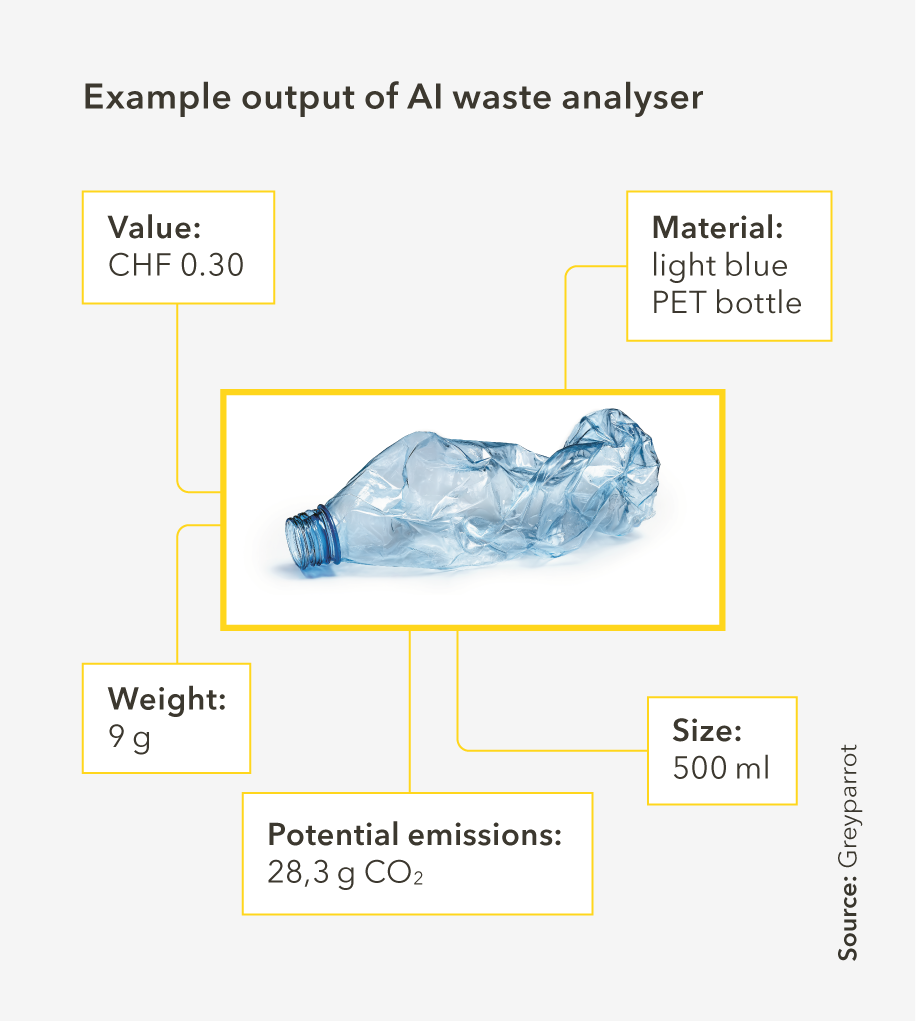
Start-up: Greyparrot, United Kingdom
With innovative “waste intelligence”, Greyparrot brings transparency to sorting facilities. Ist easy-to-install AI analyser identifies waste on the conveyor belt in real time – capturing material type, brand, and the CO2 savings potential from recycling. This improves sorting Quality – and with it, the recycling rate and CO2
savings.
Opportunities and risks – which will prevail?
Whether AI will ultimately help or harm the environment more remains to be seen. What matters is how strategically we deploy it for sustainability – and how consistently we improve its efficiency and ecological footprint. Policymakers and businesses should adopt stricter guidelines for AI use and disclose where AI technologies are climate-friendly – and where they are harmful. AI could save the world – or accelerate its decline. What matters most is who is steering it.
Discover the entire issue
Read more articles from our current issue: ‘Intelligence: the new force powering our world’.
Be part of the solution and stay informed with the Futuremover.
Subscribe now and shape the future!
Magazin abonnieren EN
"*" indicates required fields


