News & Trends
The Factory Learns

Henry Ford once said that customers could have their car in any color they wanted, as long as it was black. This logic shaped industry for more than a century. Now it is beginning to break down.
Size 38 pinches at the toes, while size 39 slips at the heel. The fact that we have spent decades choosing between standard sizes has less to do with our feet than with the logic of the factory that produces our shoes.
For more than a hundred years, industrial manufacturing has followed a simple rule: Repetition creates efficiency. Production lines are designed for specific products, and the same steps are performed again and again. The more standardized a product is, the less expensive it is to manufacture. The factory determines what is economically feasible and therefore what we can buy.
The Factory Develops a Memory
Patrick Lunz of Siemens Digital Industries believes that the real revolution is not taking place in the humanoid robots currently making headlines, but beneath their robotic skin.
“Without the data behind them, robots like these are expensive sculptures,” he says.
Modern factories generate vast amounts of data. Sensors measure temperatures, cycle times, utilization rates, and movements. For a long time, there were no effective tools for turning this data into useful insights. Only the latest advances in artificial intelligence have made it possible to analyze these volumes of data, reveal patterns, and continually improve processes. The factory is beginning to understand what is happening inside it.
From Commands to Goals
This is also changing the role of machines. Until now, people have specified every individual step a robot must perform: “Pick up the component. Move it 10 centimeters to the left. Place it on the conveyor belt.” Increasingly, people now describe the desired result: “Move this component to the next station.” The robot decides how to accomplish the task, even if the component suddenly looks different from what it expected. For Lunz, this represents the real break with the logic of the old factory. People no longer define every step. The machine understands the goal.
The Factory as a Test Lab
Before deploying new technologies at customer sites, Siemens tests them at its showcase factory in Erlangen, Germany. Digital twins play a central role. These are virtual replicas of machines, production lines, or entire factories. They make it possible to simulate processes, identify bottlenecks early, and test improvements before implementing them in the physical production environment.

In the past, we specified processes. Today, we specify goals.
Patrick Lunz, Press Officer, Siemens Digital Industries
Between Size 38 and Size 39
This makes something possible that was long considered a contradiction: industrial-scale customization. Siemens is working with Adidas on new methods of producing shoes. Instead of choosing between size 38 and size 39, customers’ feet could eventually determine how their shoes are produced. A digital scan would provide the necessary data, and individual components could be created using 3D printing. Custom-made shoes are still an exception today, but they could fit significantly more feet in the future. The implications extend far beyond achieving the perfect fit.
For more than a century, products had to conform to the factory. Now the factory could begin adapting to the products. Yet even a flexible factory faces scarcity. As the cost of many production steps falls, computing power, data infrastructure, and specialized expertise become more valuable. The bottleneck shifts from manufacturing itself to the intelligence behind it.
People Will Remain
The automation industry often uses the image of a “lights-out factory” to describe the factory of the future: a place where no lights are needed because no people work there.
Patrick Lunz expects the opposite. Even in 2040, Europe’s most advanced factories could employ a similar number of people as they do today. New technologies create new responsibilities. Tomorrow’s factory employees will design processes, analyze data, and integrate new technologies.
In the 1970s and 1980s, many people feared that robots would eliminate industrial jobs. The opposite happened. Countries that adopted automation early became more competitive and created more manufacturing jobs.
For a long time, the rule in manufacturing was simple: Anything repetitive could be automated. That logic is now beginning to change. When machines understand objectives and respond to changing conditions, variable tasks can be automated for the first time. The factory of the future will not simply produce more. It will learn to adapt.
Globalance View
Robotics is changing the production logic of entire industries and, with it, the logic of investing. We invest in companies that enable this transformation. Konecranes automates material flows, Fanuc is one of the world’s leading robotics manufacturers, and ASM International supplies key technologies for semiconductor production.
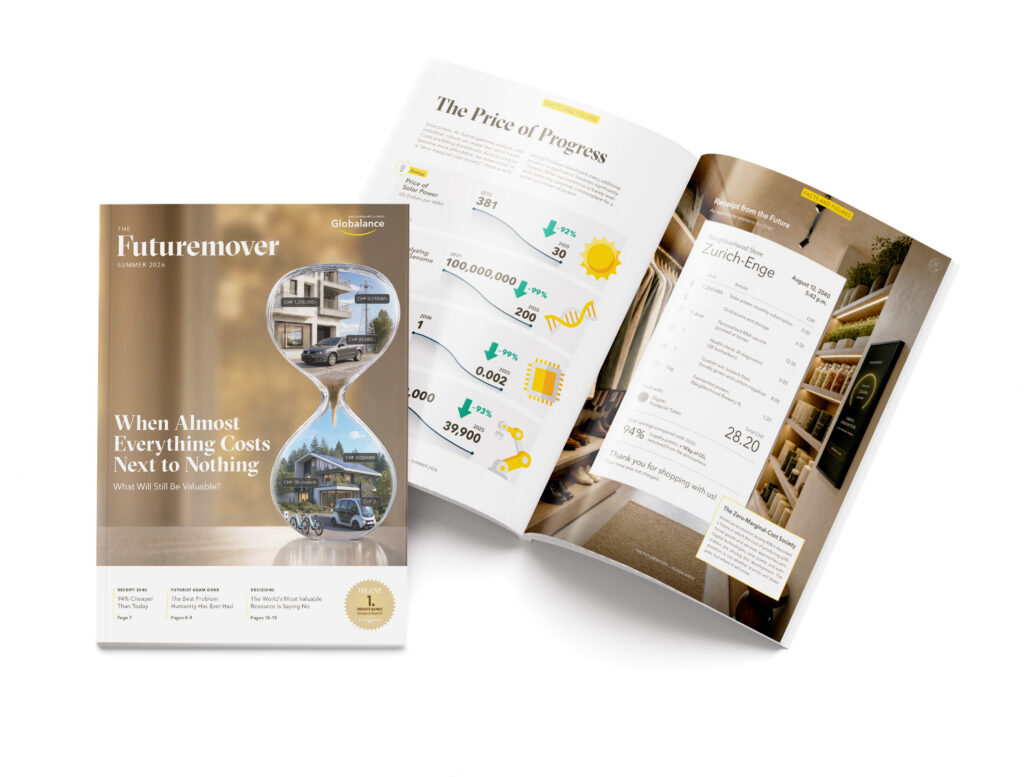
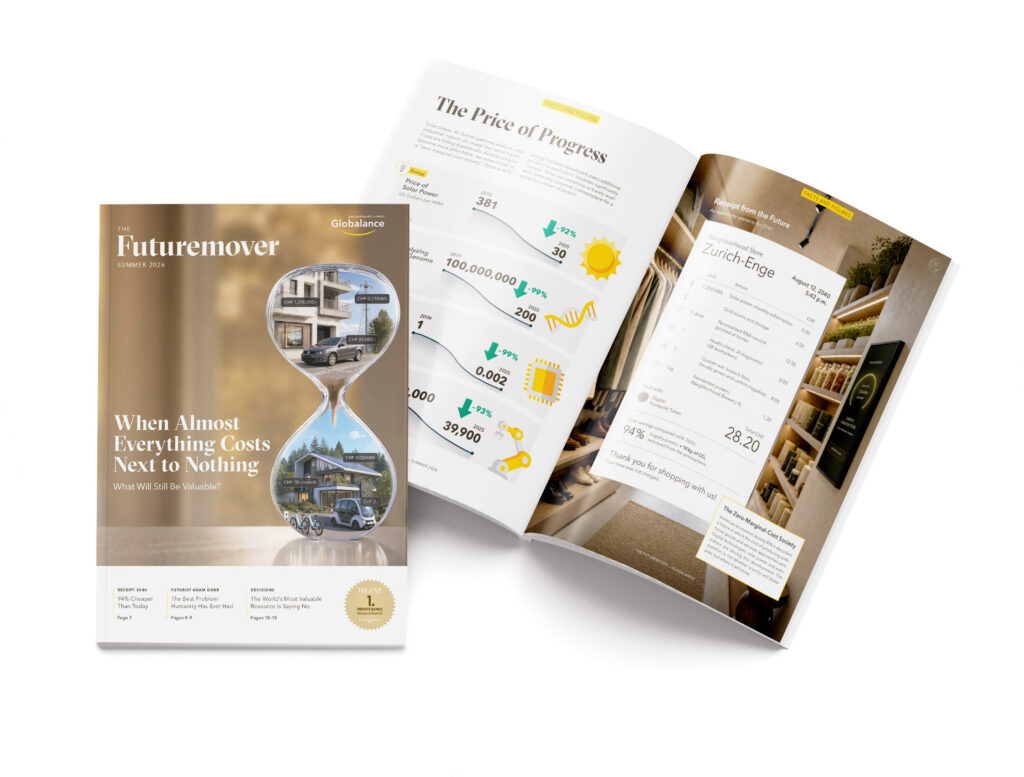
Discover the entire issue
Read more articles from our current issue: ‘When Almost Everything Costs Next to Nothing’.
Be part of the solution and stay informed with the Futuremover.
Subscribe now and shape the future!
Magazin abonnieren EN
"*" indicates required fields