News & Trends
Green is the new gold

From eco-technology to an engine of growth: cleantech is the future – and China is miles ahead of the rest of the world. Why is that? And how are the United States catching up in the race for the green crown?

Columbus, USA, 2026: James wakes up earlier than usual – the sun is warming his face. The solar array he recently installed on the roof of his single-family home, thanks to government subsidies, is already generating electricity. He drives his SUV to the office, filled up at one of the few eco-fuel stations in the country. On the way, he picks up two colleagues – carpooling comes with tax breaks. They talk about the new solar parks in Dayton and the government incentives for electric vehicles. James’ SUV still has a few good years left in it; the next one will be electric.
Tianjin, China, 2026: Wang Mei’s smart alarm clock gradually brings up the LED lighting. Rain drums against the energy-efficient windows – mandatory in new apartment buildings. Wang Mei decides to leave her gasoline scooter at home and take the electric subway to the train station instead. It runs on hydropower. On the way, she scrolls through the news. She reads about a new hydrogen-powered tourist train and learns about government subsidies for electric scooters. They could not come at a better time: gasoline keeps getting more expensive.

Two scenarios, one reality: cleantech has become an integral part of everyday life. Green technologies are the gold of the 21st century: governments and companies alike are investing heavily in them. Not only because they conserve resources and protect the environment – but because they see them as an economic and geopolitical necessity.
Those who produce their own energy have an advantage. And those who also manufacture the infrastructure themselves are completely independent. In that sense, cleantech is a matter of national security – especially in the age of AI. The green industry also holds enormous economic potential: last year, roughly one-third of China’s economic growth came from the cleantech sector. Can the United States catch up?
The costs of solar and wind power are unmatched.
Andreas Schneller, Head of ENETIA Funds, De Pury Pictet Turretini & CIE SA
From mine to product
Wang Mei orders her new electric scooter online. As with most electric vehicles, the battery, motor, and the frame come from Chinese factories and are assembled domestically. Some raw materials, such as cobalt, come from abroad but are processed in China. Meanwhile, James admires a new electric pickup truck that is almost entirely made in the United States – a rarity. The lithium for the battery comes from North Carolina. Unfortunately, production of the electric truck has already been discontinued: automaker Ford is shifting its focus to hybrid vehicles.
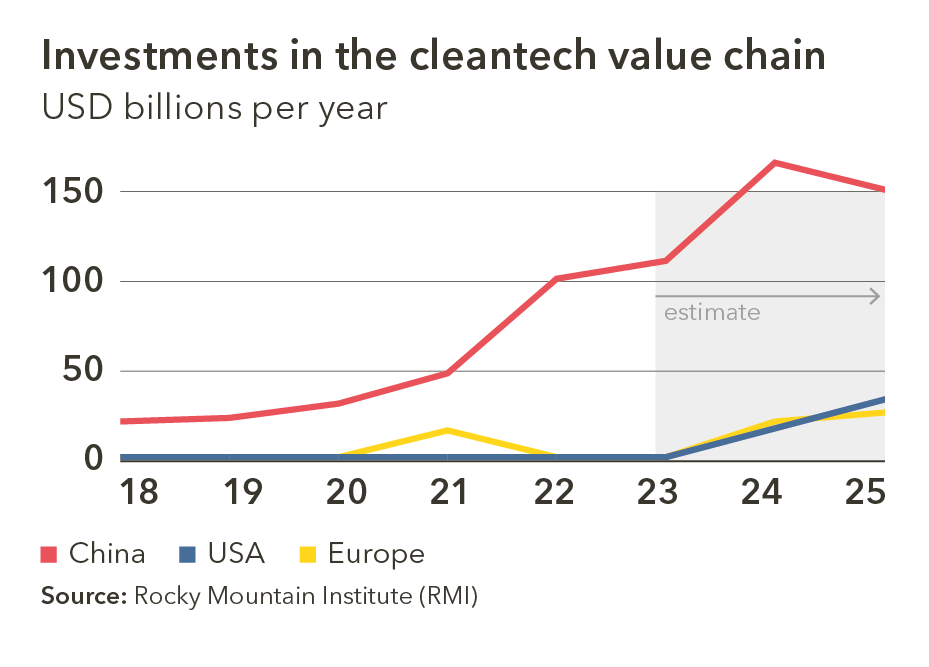
Thanks to massive investments, China is now the global leader in processing and manufacturing solar panels, wind turbines, batteries, and energy storage across the entire value chain. But the United States is catching up. The Inflation Reduction Act (IRA) of 2022 triggered a cleantech boom with attractive tax credits and subsidies – James’ electric truck is a result of that. Political shifts will not change the boom: clean energy production is here to stay in the United States as well. Not to replace oil and gas – but to complement them profitably.
January 2040: James and Wang Mei minimize their electricity consumption with AI. The batteries in their electric vehicles are recycled – without raw materials from abroad. The electricity for Wang Mei’s scooter comes from a nuclear power plant that operates without uranium, a global first. James’ home energy storage system uses solar power as well as the battery from his electric car. If that is not enough, he draws electricity from a petrothermal geothermal power plant. More and more of these plants are being built across the country.
Two strategies
Wang Mei charges her electric scooter largely with renewable energy from water, wind, and the sun – delivered via the national ultra-high-voltage grid. James relies on a traditional electricity mix of natural gas, coal, and nuclear power, supplemented slightly by wind and solar energy.
Currently, 74 percent of all large wind and solar projects are being built in China. While the country relies on a long-term government strategy and maximum scaling, innovation in the United States is driven mainly by private companies – sometimes with government support. This includes hydrogen gas turbines and geothermal energy. In Utah, for example, Google is currently financing the world’s largest petrothermal geothermal power plant. This still-young technology has enormous potential: it harnesses heat deep within rock formations and therefore requires neither natural hot springs nor energy storage.
Who will shape the future of cleantech?
The race for the green crown has two goals: achieving independence as quickly as possible – and leading global cleantech production. China has achieved both. The country still relies on coal but also deploys cleantech on a massive scale and exports it around the world. And the United States? It is catching up slowly but surely. Its strength lies in digital solutions and specialized high-end components – both central elements for long-term leadership in cleantech.

Globalance View
Cleantech is scaling globally: batteries, solar power, and electric mobility are growing rapidly.
China is shaping the cost curve: scale and industrial strength are setting new price standards.
Globalance invests in leading companies worldwide – including BYD and CATL.
Discover the entire issue
Read more articles from our current issue: ‘The race of the operating systems’.
Be part of the solution and stay informed with the Futuremover.
Subscribe now and shape the future!
Magazin abonnieren EN
"*" indicates required fields