News & Trends
«The EU model is becoming increasingly relevant.»


Alicia García Herrero
Alicia García Herrero, a Senior Fellow at the European think tank Bruegel, explains how Europe can position itself in the growing rivalry between the United States and China.
What is Europe’s elevator pitch in the current dynamic between the US and China?
We are the third option. In an increasingly bipolar world, Europe represents a credible third pole. It offers a rules-based, democratic alternative with high standards – not driven by fear or dependency, but by shared values and mutual interests. That carries significant weight.
What strategic role should Europe – and the EU in particular – play to navigate or even benefit from this ongoing tug-of-war between the superpowers?
The key concept is strategic autonomy. Europe should stop acting as a passive arena for great-power competition and instead step forward as a rule-setter – especially in areas like trade standards, technology regulation, and climate policy. Europe already exports its regulatory frameworks around the world. We should lean into that even more.
What are Europe’s strengths and opportunities?
Europe has the world’s largest single market. The EU is built on the rule of law and strong institutional stability. As a soft power, Europe enjoys global trust and has diplomatic credibility across the Global South. It is also a leader in green technology and regulation, supported by a strong industrial base.
«In an increasingly bipolar world, Europe is a credible third pole.»
How has the rise of AI changed the dynamic?
Artificial intelligence has opened a third front in the competition between the superpowers – and for now Europe is largely watching from the sidelines. The U.S. has OpenAI, Google, and Anthropic; China has DeepSeek and Alibaba. Europe has world-class AI research with players like Mistral and DeepMind, but it lacks the capital and the data ecosystem. The risk is that Europe becomes a consumer and regulator of AI without producing it. The opportunity is to position itself as the global standard-setter for trustworthy AI – something the EU AI Act is already moving toward.
Is the EU a successful model of interstate cooperation at a time when many countries are turning inward?
Yes. The EU – a union of 27 sovereign states – is imperfect, slow, and at times maddening, but it works. Challenges such as pandemics, climate change, or potential AI crises cannot be solved by any country alone. That’s where the EU model of pooled sovereignty becomes increasingly relevant. In the long run, the side that builds the strongest alliances will win this tug-of-war – and Europe could well be that side.
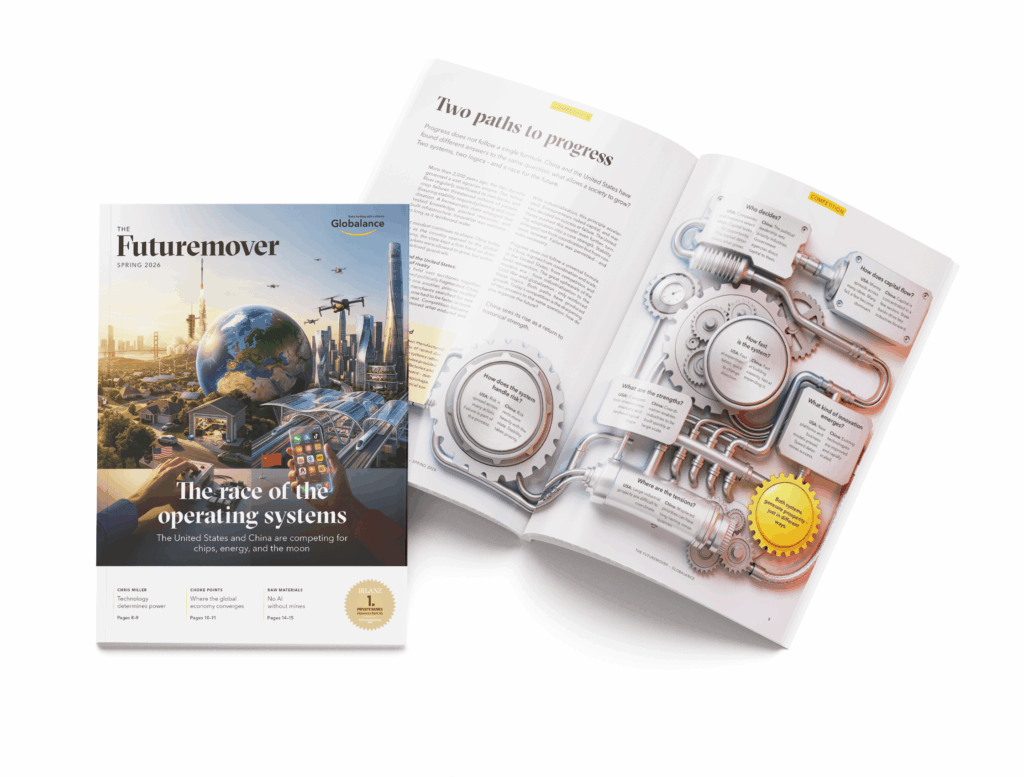
Discover the entire issue
Read more articles from our current issue: ‘The race of the operating systems’.
Be part of the solution and stay informed with the Futuremover.
Subscribe now and shape the future!
Magazin abonnieren EN
"*" indicates required fields