News & Trends
Two paths to progress

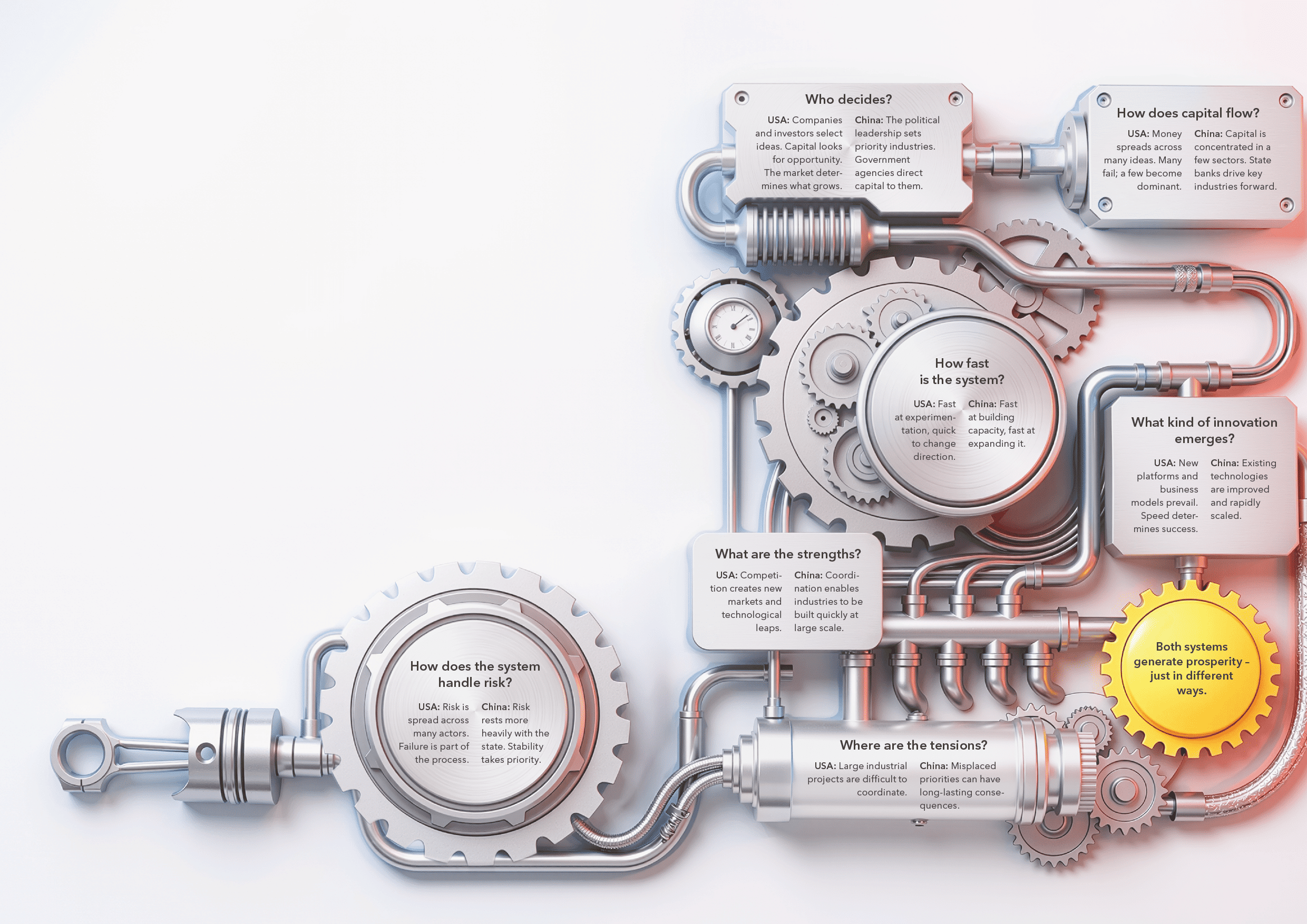
Progress does not follow a single formula. China and the United States have found different answers to the same question: what allows a society to grow? Two systems, two logics – and a race for the future.
More than two thousand years ago, the Han dynasty governed a vast agrarian empire. The Yellow River regularly overflowed its own banks, and crop failures threatened millions of people. Ensuring stability required planning and coordination. A bureaucratic state emerged that tested knowledge, pooled resources, and built infrastructure. Innovation was welcome – as long as it reinforced order.
That mindset continues to shape China today. Even as the country opened to the global economy, the state kept a firm hand on direction. Markets were allowed to grow, but within clearly defined guardrails.
Europe and the United States: the power of rivalry
While China held vast territories together, Europe remained politically fragmented. Cities competed with one another, princes rivalled each other, and merchants searched for new routes. To survive, one had to be faster or more inventive than the rest. Competition became the filter that determined what endured and what disappeared.
With industrialization, this principle accelerated. Entrepreneurs risked capital, and markets decided on success or failure. The United States pushed this model even further, turning adaptation into a core strength. Stability emerged not from coordination but from constant renewal. Failure was permitted – and even necessary.
Progress does not follow a universal formula. In China, it grows from coordination and scale; in the United States, from competition and bold reinvention. The great upheavals of the modern era – from industrialization to the Cold War and globalization – only reinforced these logics. Both paths have produced growth. Today’s competition is the sharpening of two answers to the same question: how do you organize the future?
Rivals – and yet intertwined
Silicon Valley developed while Shenzhen manufactured. The major technological breakthroughs of recent decades emerged from the interaction of two systems rather than from either acting alone. The United States provided capital, research, and platforms. China built factories and drove down costs. Tensions were always present – over technology transfers, state subsidies, and espionage. What is new today is that security and technological sovereignty now matter more than efficiency.
Who is investing more in the future?
Anyone who wants to shape the future has to finance it. In factories, research labs, and digital infrastructure, it becomes clear which economy will set the direction tomorrow.
The United States and China invest differently. China concentrates capital through the state, scales industry, and plans in multi-year programs. The United States relies more heavily on private capital, research, and venture funding to rapidly translate new technologies into marketable applications. The numbers therefore do not show a simple winner. Instead, they reveal how the future takes shape: in one case through scale, control, and industrial depth; in the other through speed, innovation, and capital markets. What matters is not only how much is invested, but what structures grow from it.

Discover the entire issue
Read more articles from our current issue: ‘The race of the operating systems’.
Be part of the solution and stay informed with the Futuremover.
Subscribe now and shape the future!
Magazin abonnieren EN
"*" indicates required fields