News & Trends
Architect of the new rules

Politically and economically, European countries find themselves in a strategic dilemma between the United States and China. What defines Europe – and how can it turn this position to its advantage?
From an ancient world power to the deeply religious Middle Ages, from the Enlightenment through colonialism to the World Wars: our continent has experienced a great deal. As a geographic entity, it looks back on a rich history. As a political union, however, the EU is a relative newcomer on the geopolitical stage. Who belongs to the team – and what rules apply? How can all these different interests be reconciled? Shaped and informed by their past, European countries are renegotiating fundamental questions in the present. This brings enormous opportunities, but also many risks. Where does Europe stand in the tug-of-war between the superpowers?
The one who benefits?
“In an increasingly bipolar world, Europe is a credible third pole,” says Alicia García-Herrero, Senior Fellow at the European think tank Bruegel (BE). As a rule-based, democratic alternative with high standards, Europe is an extremely valuable partner – shaped by shared values and interests.
In a world where countries are once again turning inward economically, the EU offers a model for successful transnational cooperation.
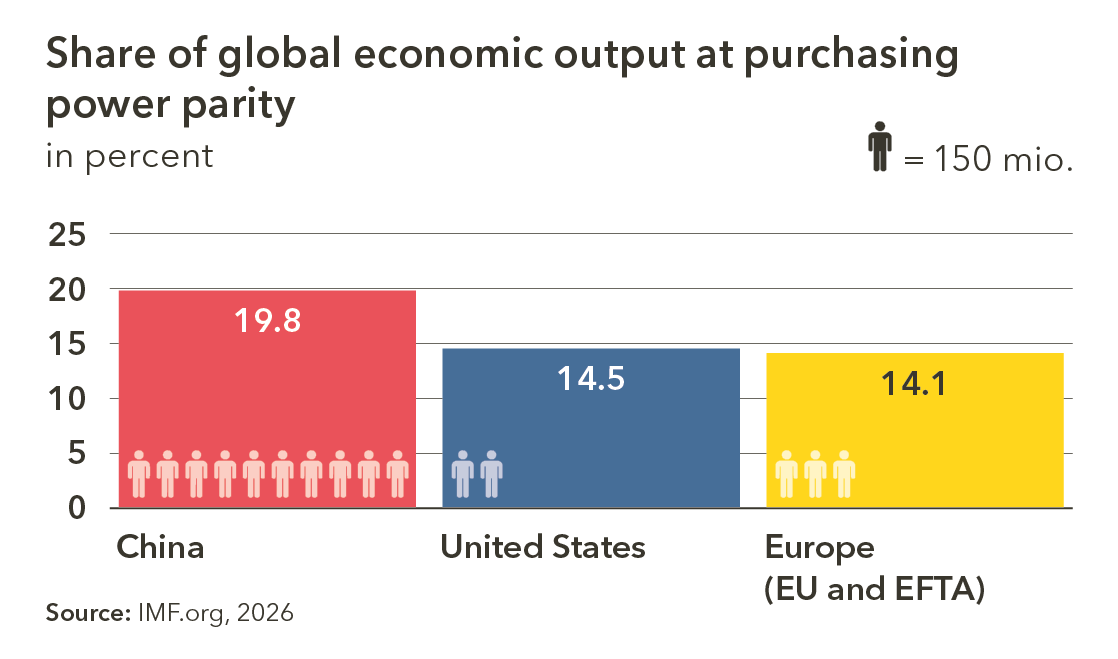
From cleantech to online security, the EU exports standards and regulations around the world. Europe also ranks among the global leaders in market size and purchasing power. The European economic area – consisting of the 27 EU nations as well as the three EFTA states Norway, Iceland, and Liechtenstein – is the largest single market in the world. Anyone seeking access to this lucrative market must play by European rules. “We should rely on that even more,” says García-Herrero. “In the long run, the tug-of-war will be won by whoever builds the strongest alliances. And that could very well be Europe.”
Raw materials – weak in extraction, strong in processing
Europe has few active mines for critical minerals and rare earths, but it is strong in processing, refining, and exporting them. To secure supply chains, the EU is working on deeper partnerships with Africa and Latin America. The EU’s Critical Raw Materials regulation promotes projects that identify deposits in Europe and make them usable in the long term.
Space –
behind, but not out of the race
Without a European counterpart to SpaceX and with fragmented national programs, Europe risks playing only a minor role in the emerging space economy. Yet, even if the EU is not leading in space, the European Space Agency has considerable expertise. Programs such as Galileo satellite navigation system and Copernicus Earth observation program are technologically strong, and manufacturers such as the ZEISS Group are in demand worldwide.
Cleantech –
a contested pole position
In renewable energy, the EU holds a global political leadership role but is losing industrial ground: it sets the rules while others build the factories. Chinese cleantech products are unmatched in price, while the United States is heavily subsidizing the sector. In wind power, however, Europe is among the global leaders. Europe is also establishing itself as a hub for intelligent power grids.
“In an increasingly bipolar world, Europe is a credible third pole.”
Alicia García Herrero is a Senior Fellow at the European think tank Bruegel (BE). In the interview, she explains how Europe can assert itself in the rivalry between China and the United States.

Discover the entire issue
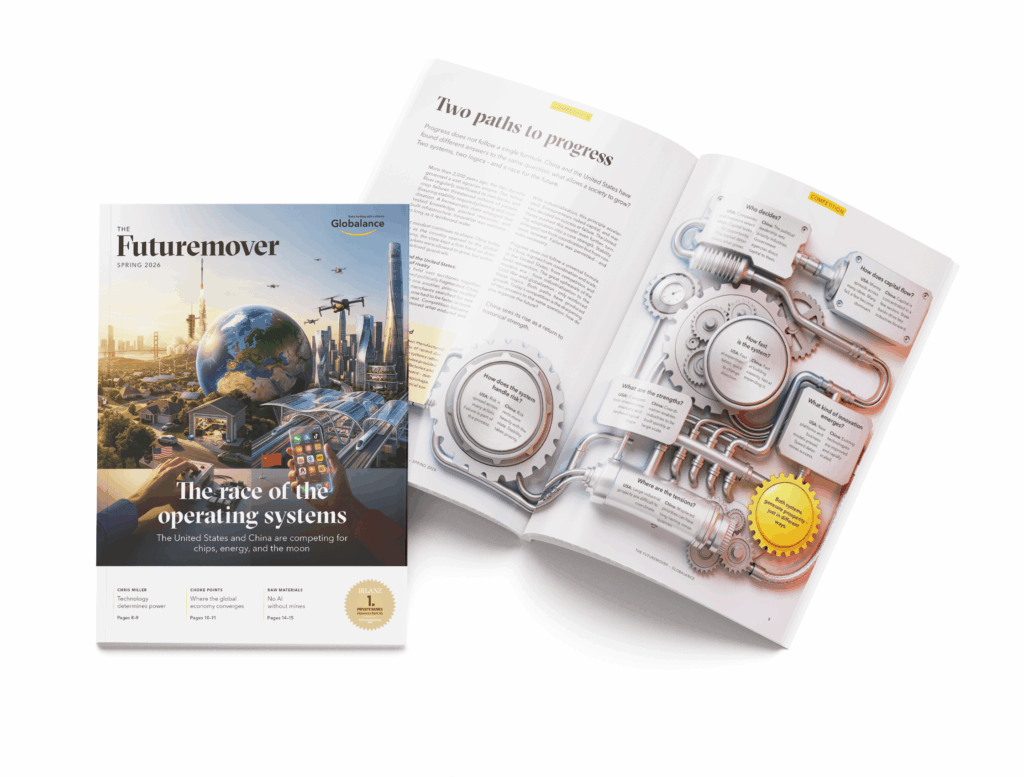
Read more articles from our current issue: ‘The race of the operating systems’.
Be part of the solution and stay informed with the Futuremover.
Subscribe now and shape the future!
Magazin abonnieren EN
"*" indicates required fields