News & Trends
The coordinates of power

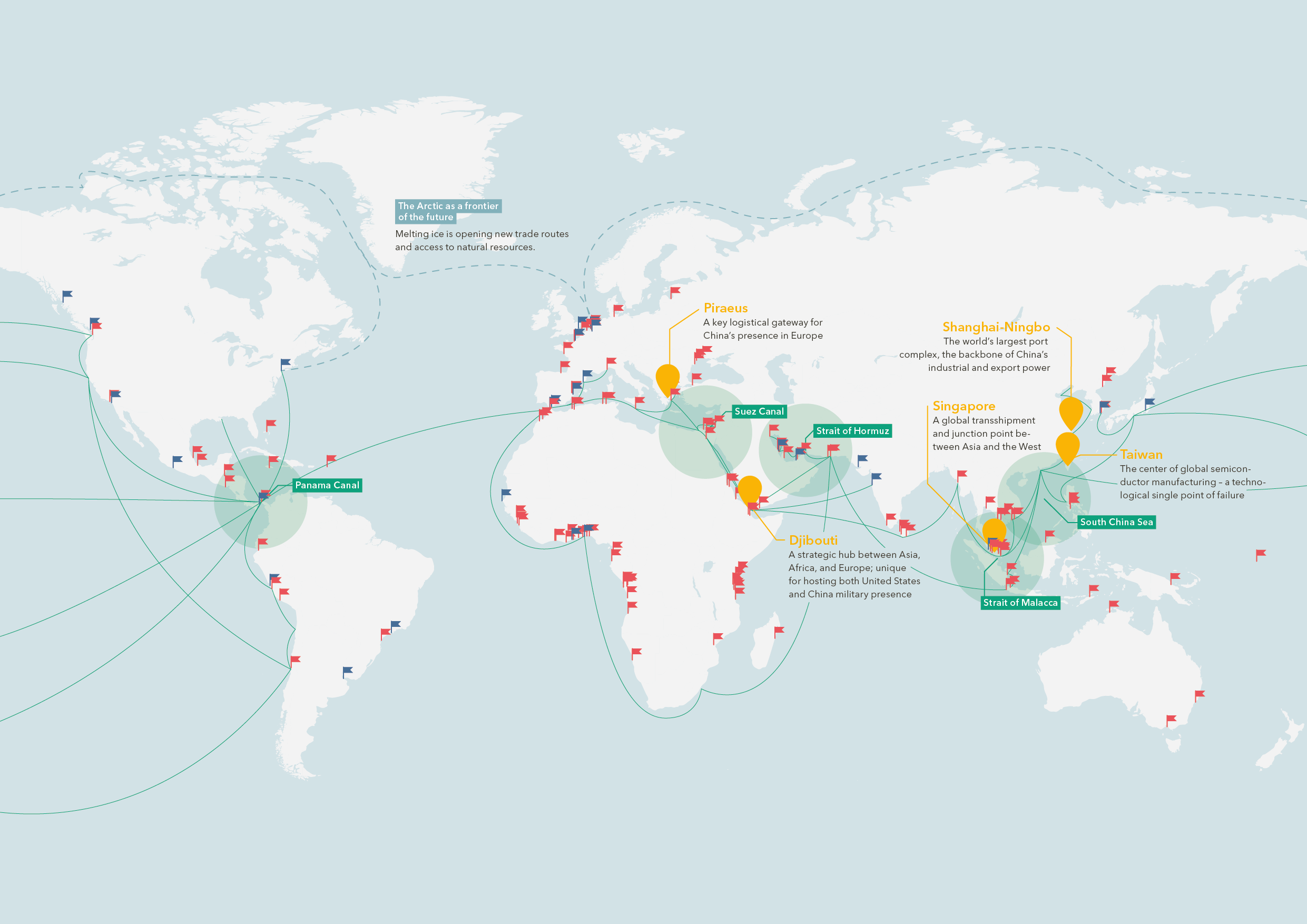
Power rarely reveals itself at first glance. It is anchored in ports where thousands of containers stack up every day. In narrow straits through which a large share of global trade flows. In factories that produce critical technologies. And in the depth of the sea: fiber-optic cables carry data racing around the globe.
The new playing field
In Shanghai and Singapore, in Taiwan, at the Suez Canal or in Djibouti, economic dependencies converge – and with them the competition between China and the United States. Here, infrastructure becomes geopolitical weight.
Both countries pursue their own strategies. China is expanding its economic presence and tying entire regions more closely to itself through ports, logistics, and long-term dependencies. The United States, by contrast, relies more on alliances, rules, and military reach. This map focuses on the economic side of the competition – on the places where geopolitical rivalry becomes visible in the everyday workings of the global economy.
According to Rana Foroohar, economic columnist at the Financial Times, the situation today is far more complex than earlier power conflicts. The Cold War was comparatively clear-cut – today, cooperation and competition often unfold at the same time.
The map therefore does not show a rigid confrontation. Instead, it highlights the spaces where this competition is playing out today – and new ones that are just beginning to open. One example lies far to the north, in the Arctic, where the ice is retreating and new routes are emerging.
In the ice of the arctic
Aboard an icebreaker heading toward the North Pole, Rana Foroohar witnessed how a new race for trade routes is beginning. The Financial Times columnist explains why geopolitical power today is increasingly shaped through trade routes, supply chains, and financial markets.

Rana Foroohar is a Global Business Columnist and an Associate Editor at the Financial Times. The award-winning journalist writes about globalization, financial markets, and shifting geopolitical power. Her next book, Sea Change: The New Great Game in the Arctic Circle, will be published in October 2026.
Why has economic power moved to the center of the competition between the United States and China?
The Cold War was relatively straightforward: two blocs, two ideologies, two military systems. Today the world is far more complex. Countries compete with one another while also cooperating. The rivalry is no longer defined primarily by military front lines. It runs through trade flows, industry, and infrastructure. At its core, the question is geo-economic: Who will control prosperity and influence in the future?
Why has the economy become so political today?
We are remembering that the economy has always been political. For decades, many people acted as if markets could function independently of power. Capital, production, and trade were supposed to flow simply to wherever they could be used most efficiently. But these economic flows shape power structures – and that is becoming visible again.
What role does China play in this competition?
China approaches economic power with a very long-term perspective. A look at its five-year plans shows that the country is deliberately building control over strategic sectors – key industries, critical infrastructure, and strategic raw materials such as rare earths. These decisions often take years to show their full effect. But when they do, they can suddenly shift entire power dynamics.
Where is this competition particularly visible?
A good example is the Arctic. Some time ago I was on an icebreaker myself—traveling from Alaska toward the North Pole. While we were mapping the seabed, Russian ships kept appearing that were doing exactly the same thing. Everyone is trying to determine where resources lie – and which new trade routes might emerge as the ice continues to melt. It strongly recalls the “Great Game” of the 19th century – the rivalry between Britain and Russia over influence, resources, and trade routes in Central Asia. History has seen such phases many times before.
40%
cheaper and faster transport could be achieved along Arctic routes compared to the Suez or Panama Canal, according to estimates.
700bio.
USD per year is being invested by the five largest U.S. tech companies in data centers and AI infrastructure.
2tn.
USD in loans has already flowed into the AI boom.
Does the global economy follow a particular pattern?
The world moves like a pendulum. Over longer periods, two phases alternate. At times, cross-border trade expands and supply chains stretch across continents. Then governments step in more strongly again. After decades of hyper-globalization, the pendulum is beginning to swing once more. Industrial policy, raw materials, and supply chains are moving to the center of geopolitical strategies.
Many countries are currently trying to reduce economic dependencies. How realistic is that?
A complete decoupling is unrealistic – the success of globalization was simply too great. Over decades, supply chains have emerged that now connect almost every industry. Rather than decoupling, greater resilience is more realistic. Strategically important products should be produced in several locations – not in just one.
At its core, this is a geo-economic competition: Who will control prosperity and influence in the future?
You also see new risks emerging in the financial system. Why?
The competition between the United States and China is driving enormous investment in technology, especially artificial intelligence. Data centers and chips require vast amounts of capital. A large share of this investment is financed through debt. At the same time, the technology sector’s debt burden is growing rapidly. By 2030, major U.S. tech companies could account for more than half of all new corporate debt in the United States.
If an imbalance emerges between debt and revenue, that can quickly become a risk for financial markets. In such a situation, China could try to reshape the international financial order – for example, by shifting more global trade into the Chinese currency rather than the U.S. dollar. The competition will therefore not be decided only through technology or military power. It will also play out in capital markets.
Despite these tensions, what makes you optimistic?
Competition is pushing many countries to rethink their economic structures. Companies are diversifying their supply chains, and governments are defining their industrial policies more clearly. In the long term, this could even lead to a more stable global economy – with greater resilience and fewer dangerous dependencies.
Discover the entire issue
Read more articles from our current issue: ‘The race of the operating systems’.
Be part of the solution and stay informed with the Futuremover.
Subscribe now and shape the future!
Magazin abonnieren EN
"*" indicates required fields