News & Trends
When the government shapes industry

Chips, batteries, artificial intelligence: governments are increasingly helping shape the technologies of the future. Historian and bestselling author Chris Miller explains why relying on the free market alone is no longer enough.
The Taiwanese chip company TSMC is currently building a major factory in Arizona. How did that come about?
Just a few years ago, TSMC would hardly have located its most advanced production outside Taiwan. It was only American subsidy programs that made building in Arizona attractive. This shows just how directly industrial policy now shapes corporate investment decisions.
You argue that industrial policy has always existed. Why is it back in the spotlight today?
For years, China has heavily supported key industries – from solar energy and batteries to semiconductors. Other countries are responding. They want to ensure their companies aren’t competing on a distorted playing field.
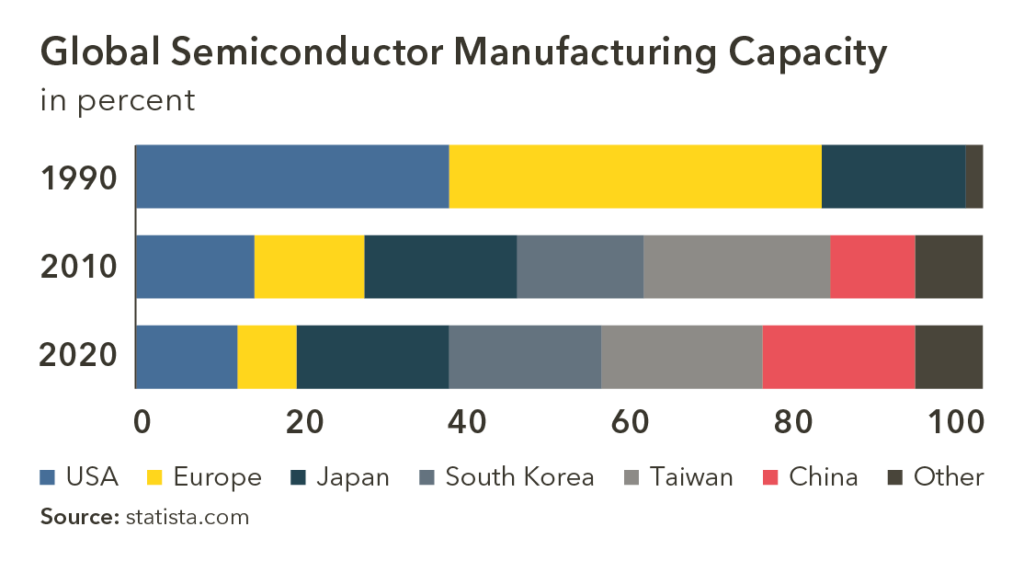
Chip production shifts to East Asia
Since the 1990s, semiconductor manufacturing has increasingly moved to Taiwan, South Korea, and China. The United States and Europe are now trying to rebuild their own production capacity.
Why are governments intervening so strongly in chips and artificial intelligence (AI)?
Because both are expensive – and because power is at stake. A modern chip fabrication plant costs many billions of dollars, and those who gain the technological lead often keep it for years. These technologies have always had military significance as well. Governments have strongly driven the development of computers and chips from the very beginning – and continue to do so today.
What role do companies play in this?
In China, the state is more deeply embedded in corporate structures. Many companies have party representatives who can influence strategic decisions. In the United States, the situation is different. Corporate executives regularly clash with the government or Congress. Companies primarily follow economic incentives.
Does the Chinese model also have weaknesses?
Yes – aviation illustrates this. China aimed to break into the global market with its own large commercial aircraft. So far, that has only been partially successful. These aircraft are rarely exported and still contain key components from the United States and Europe – for example engines. Industrial policy can reshape markets, but it does not guarantee technological success.
Industrial policy is the new defense strategy.
The competition between the United States and China is also reshaping global supply chains. Are two technological worlds emerging?
Fragmentation is increasing. In key technologies, countries are investing billions to build their own production capacities. Parallel supply chains are emerging – one for China, one for the West. That comes at a high cost. Through the CHIPS and Science Act, the US is providing around 50 billion US dollars, while China is also investing billions to become more independent in semiconductors.
What are the consequences of this fragmentation?
It can slow down new developments. In China, companies are sometimes pushed to use domestic AI chips even though imported ones may be more powerful. In the United States, security regulations complicate the sale of cars with Chinese software. This protects domestic companies, but it can also weaken competition.
The chip shortage
During the pandemic, supply chains broke down and factories fell silent: the absence of a tiny semiconductor was enough to throw entire industries into turmoil. In the United States, the government stepped in, using the CHIPS and Science Act to create incentives for new fabrication plants. Companies still decided for themselves where to build and whom to partner with. In China, the leadership declared semiconductors a strategic industry and used the state-backed Big Fund to channel capital to manufacturers in order to build domestic supply chains.
Who adapts faster to this technological competition – politics or companies?
Surprisingly, in the United States it has been the political system. Washington recognized early how dependent the country had become on Asian chip supply chains. But many large tech companies have hardly changed their production structures. Apple and Nvidia remain heavily dependent on China and Taiwan – and would be poorly prepared for a geopolitical crisis.
In China, we sometimes see the opposite. Tech companies there learned early how to deal with geopolitical tensions. The political leadership, on the other hand, realized only relatively late how strategically important artificial intelligence is.
Could competition between systems actually accelerate innovation?
When several states simultaneously strive for technological leadership, they invest heavily in research. We see this today with AI, quantum computing, and new biotechnologies. Governments are funding programs, and companies are investing billions. This competition increases costs – but it can also accelerate the pace of innovation.
What question are we still asking too rarely about this technological competition?
How societies react when new technologies enter everyday life. In the United States, resistance is already emerging against large data centers or the use of AI. That can slow developments, but it also brings problems to light early. In China, criticism is far less public. That can create speed, but it carries other risks. Which society will ultimately manage new technologies better remains an open question.

The historian of the chip age
Chris Miller is a historian and professor at Tufts University near Boston. With Chip War, he wrote a The New York Times bestseller on the geopolitical importance of the semiconductor industry. His research focuses on technology, industrial policy, and geopolitical competition.
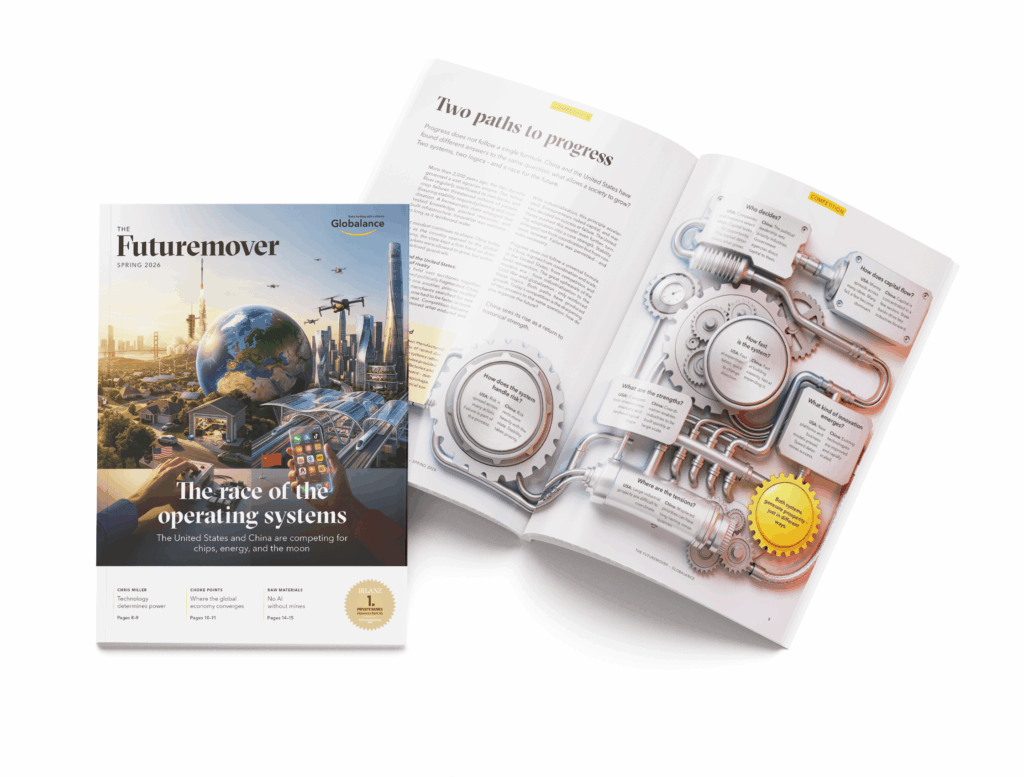
Discover the entire issue
Read more articles from our current issue: ‘The race of the operating systems’.
Be part of the solution and stay informed with the Futuremover.
Subscribe now and shape the future!
Magazin abonnieren EN
"*" indicates required fields