News & Trends
Who owns space?

Rocket launches, moon landings, and satellite fleets: the United States and China are competing for space. Not only to explore it – but to secure a long-term presence beyond Earth. What does that mean for our lives on Earth?
Bits and bytes race from orbit down to Earth, connecting us to the internet even on remote vacation islands and telling us whether we should pack an umbrella. But satellites do more than guide our daily routines – they are also the invisible control hubs of power: for financial markets, climate policy, and the military.
Space also offers previously untapped potential: data centers on the moon and mining on Mars are no longer science fiction. They are increasingly discussed as part of a booming new “space economy.” The question becomes unavoidable: who owns space – and who will write the rules for its future?
«At a showdown in space, everyone loses.»
Max Mutschler, Senior Researcher, Bonn International Centre for Conflict Studies
Space belongs to everyone
Under the 1967 UN Outer Space Treaty, the exploration and the use of outer space are the responsibility of all humankind and must be conducted peacefully. In the Artemis Accords (2020), the United States reaffirmed this intention together with the 61 nations that have since signed the agreement – China is not among them for political reasons.
“I consider it rather unrealistic that in the next ten to twenty years we will mine resources in space on a large scale or operate data centers on the moon,” says Max Mutschler, Senior Researcher at the Bonn International Centre for Conflict Studies. “A more urgent question is how we can protect ourselves from escalation in space.”
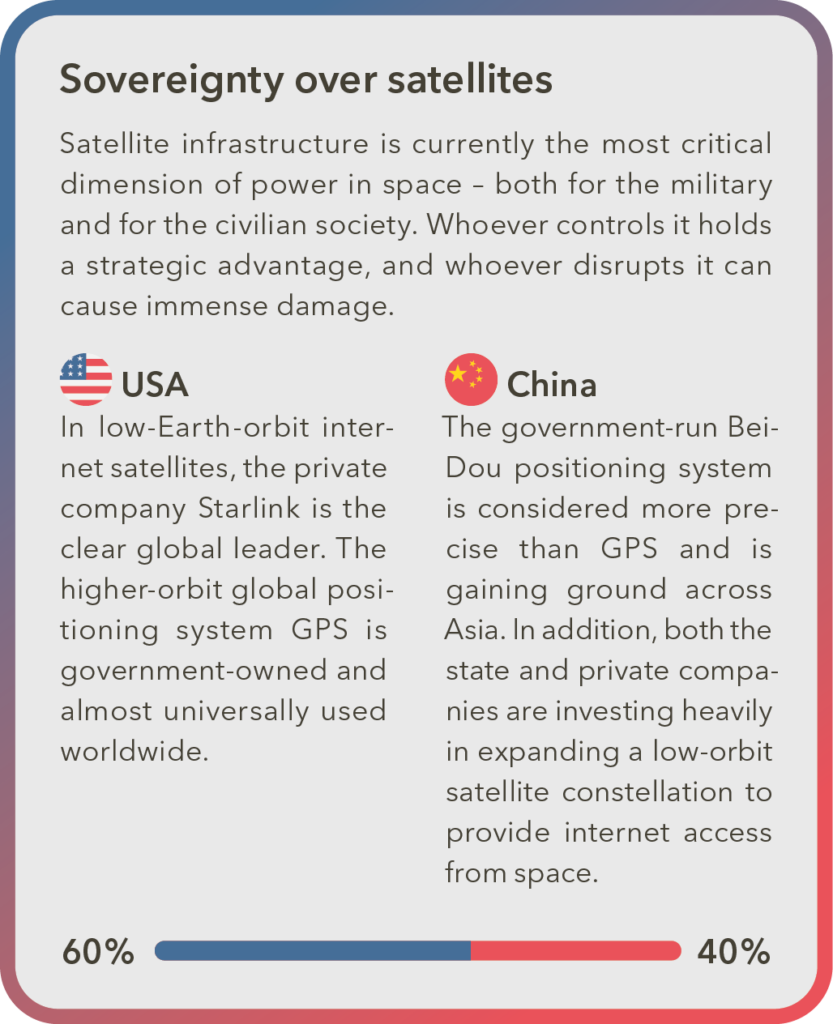
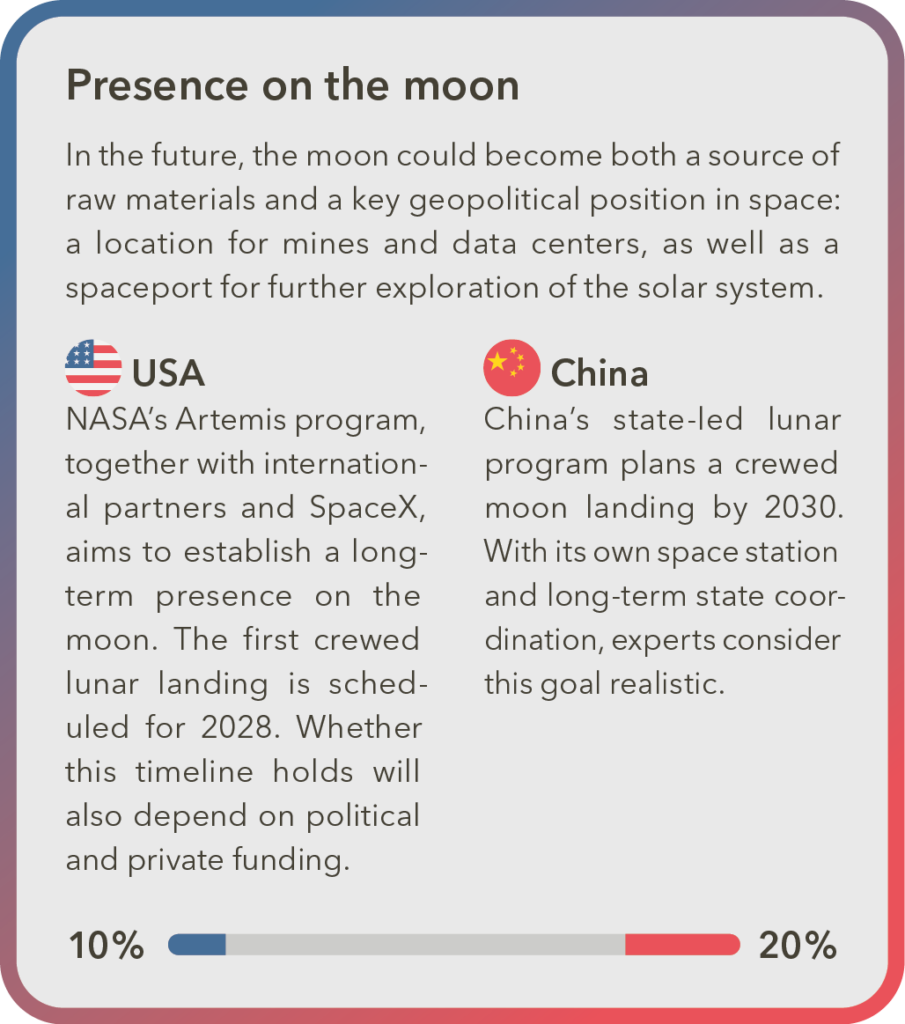
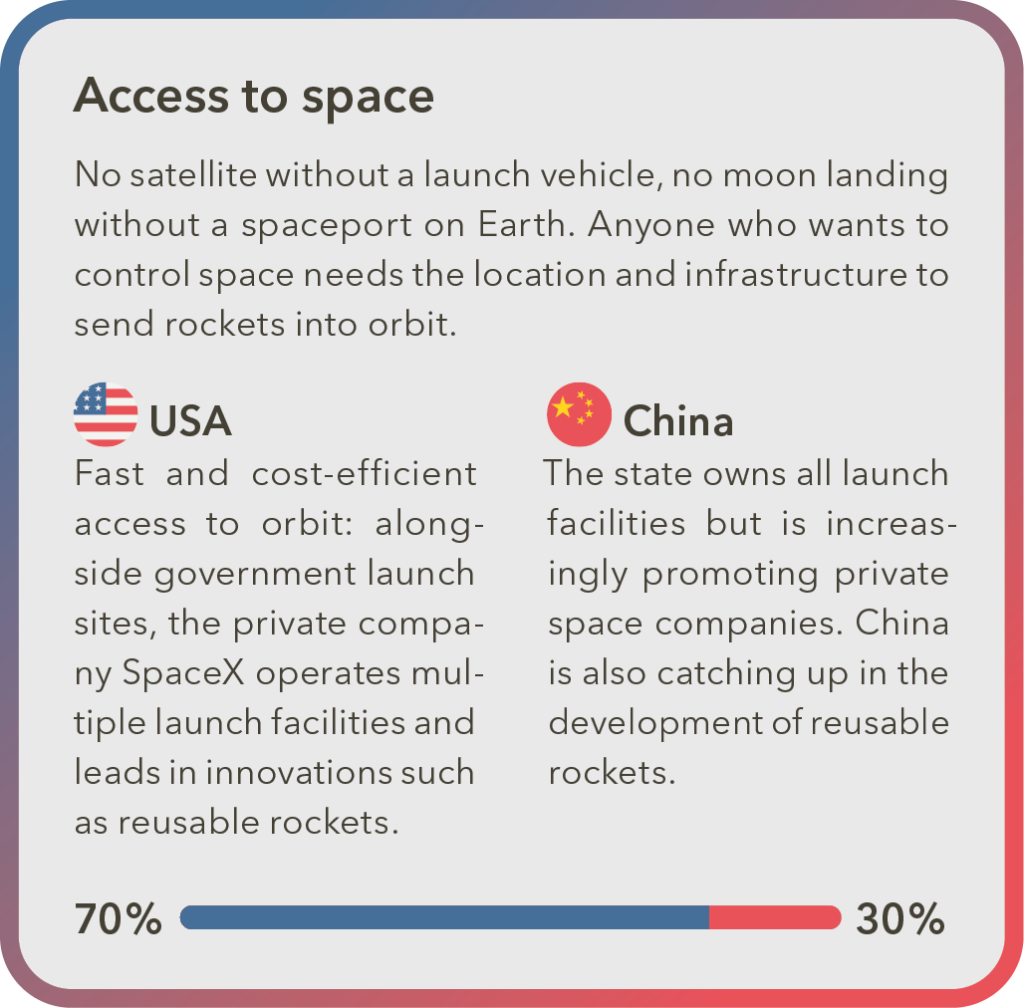
The new space race is not about symbolic flags – it is about control and influence. From rocket launches on Earth to satellite fleets in orbit and bases on the moon, the power struggle in space unfolds across three dimensions. China or the United States – who has the stronger hand?
Using the space economy sustainably
Whoever wins, one thing is clear: “In a confrontation in space, everyone loses,” says Max Mutschler. Competition on both sides creates friction and, in the worst case, could escalate militarily. Yet if space truly belongs to everyone, the emerging space economy also holds unique potential for cooperation. The fundamental question is: how can we use it more sustainably?
The USA leads, China is catching up fast
The power contest remains intense. The United States relies on an ecosystem of government and private entrepreneurs, while China focuses more on state control and strategic presence. The strategy of the USA accelerates innovation, reduces costs, and opens markets. China, by contrast, secures sovereignty and plans for the long term. Which strategy will prove stronger remains to be seen.

Globalance View
Satellites are becoming critical infrastructure: they enable navigation, communication, and Earth observation.
The space economy is expanding: demand for connectivity, data, and precise positioning is rising.
Globalance invests along the value chain: companies such as Trimble and Iridium Communications illustrate this approach.
Discover the entire issue
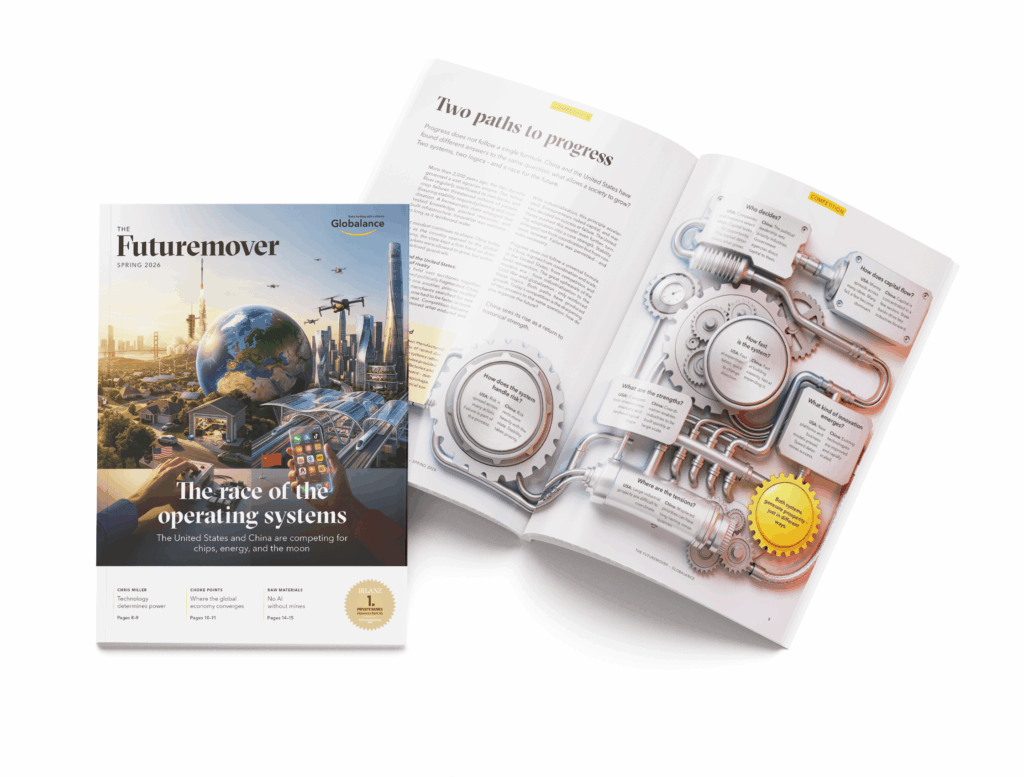
Read more articles from our current issue: ‘The race of the operating systems’.
Be part of the solution and stay informed with the Futuremover.
Subscribe now and shape the future!
Magazin abonnieren EN
"*" indicates required fields