News & Trends
«We Are Entering Uncharted Territory»

Are we facing the greatest transformation in human history? Futurist Adam Dorr studies technological disruption and understands its recurring patterns. He is convinced that the transition from scarcity to abundance has already begun.
Adam Dorr, you say that technological change always follows the same script. What is it?
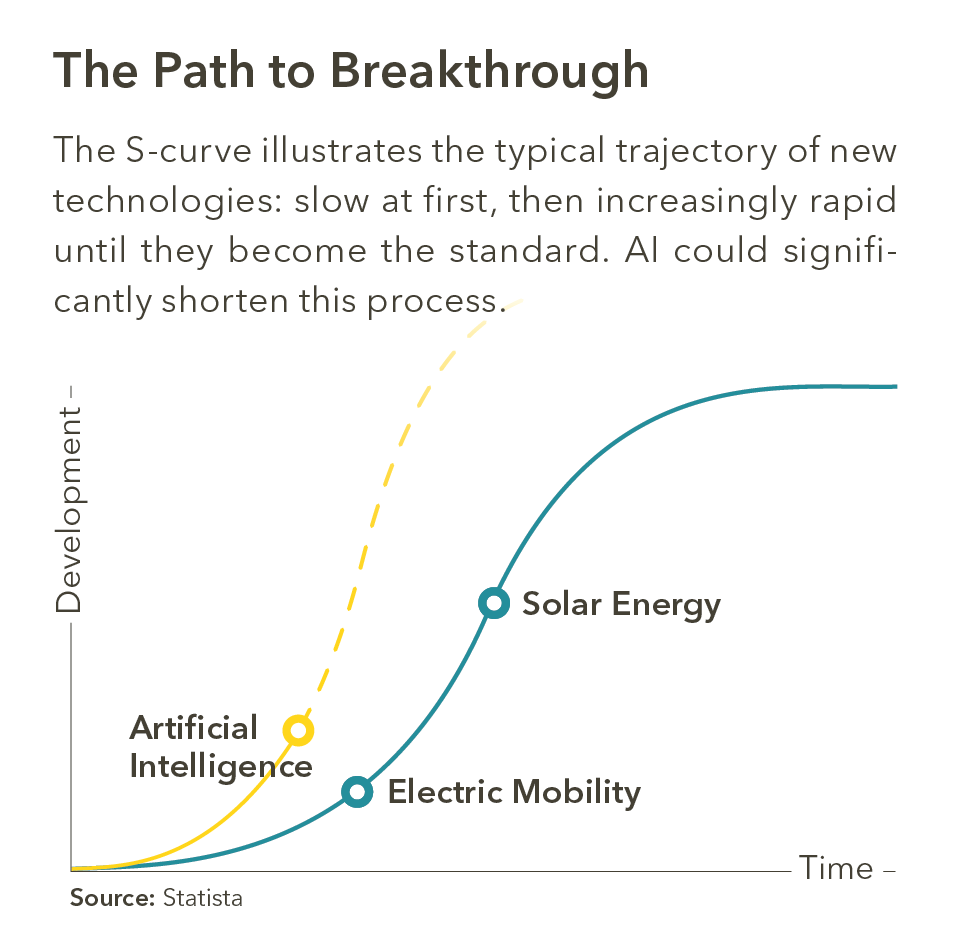
Many technological transformations follow a remarkably similar path: slowly at first, then suddenly. My team has documented almost 2,000 such transformations, from Stone Age arrowheads to smartphones. The pattern is always the same. A new technology initially gains ground gradually, then expands explosively until it reaches a saturation point. The actual transformation often takes only 15 years.
Where are we today?
Consider three examples. Solar power is already in the middle of its acceleration phase, while electric mobility is only at the beginning. AI is different. For a long time, I thought we were still in an early phase. The past 18 months have surprised me. The AI transformation is moving faster than anything we have experienced before.
Why is today’s transformation faster than previous technological leaps?
For the first time, technologies are changing not only individual products or industries, but the two fundamental foundations of every economy: energy and labor. When both become inexpensive, everything else becomes less expensive as well, including food and mobility.
Human civilization has been built entirely around scarcity. For millions of years, there was never enough: not enough food, not enough warmth, and not enough of almost anything. If that changes, human existence itself changes.
We thought we had decades. We do not.
What does that mean for markets and companies?
Look at your smartphone. It combines maps, music, credit cards, cameras, and telephone services in a single device. What used to be separate industries has converged into one product. The same will happen with physical goods when energy and labor become extremely inexpensive. No one can predict which products will converge or what business models will emerge. After all, no one foresaw social media in 2000.
Who will be caught off guard by this transformation?
The energy and transportation industries are preparing. Knowledge-based professions, including law, science, and software development, have not yet fully confronted what is coming. Four years ago, almost no one would have expected AI to be as capable at programming as it is today. Even my team was surprised.
How do you navigate without a map?
You have to experiment and stop punishing failure. The only thing that helps is to try, learn, and keep moving. Most attempts will not work, and we have to accept that as a society. For a long time, we thought we still had decades to prepare for this transformation. We do not. It is time to start moving.
Will we create tomorrow’s scarcity ourselves?
I believe that is likely. Systems try to preserve themselves. We may create manufactured work, artificial bureaucracy, and jobs with no genuine value so that the old model can continue. In the short term, this might be necessary to maintain stability. In the long term, it would become a trap. We would squander precisely what technology has made possible.
What remains valuable when energy, labor, and goods cost almost nothing?
Authenticity: the original and the genuine. The Mona Lisa can be copied perfectly, but the copy remains worthless. In a world of abundance, things made by people and experiences that cannot be repeated become the new scarcity. This applies to a handmade pair of shoes just as much as it does to experiences and relationships.
What is the real challenge beyond technology?
The question of meaning. For thousands of years, work has given people a sense of identity. Our family names still reflect this today: Smith, Carpenter, Miller. What happens to us when AI and robotics take over these roles? Throughout history, wealthy people have always found ways to give their lives meaning through family and community. But the transition will be difficult. We will have to create a new social contract.
The best problem humanity has ever had.
Yet you remain optimistic. Why?
Because the alternative would be worse: not having enough for everyone. Humanity lived with that problem for thousands of years. The question of how to distribute abundance is the best problem humanity has ever had.
Adam Dorr
is Director of Research at RethinkX, an independent think tank based in San Francisco. He studies technological disruption and its consequences for society, from energy and mobility to food and labor. His research informs the strategies of companies and governments around the world.
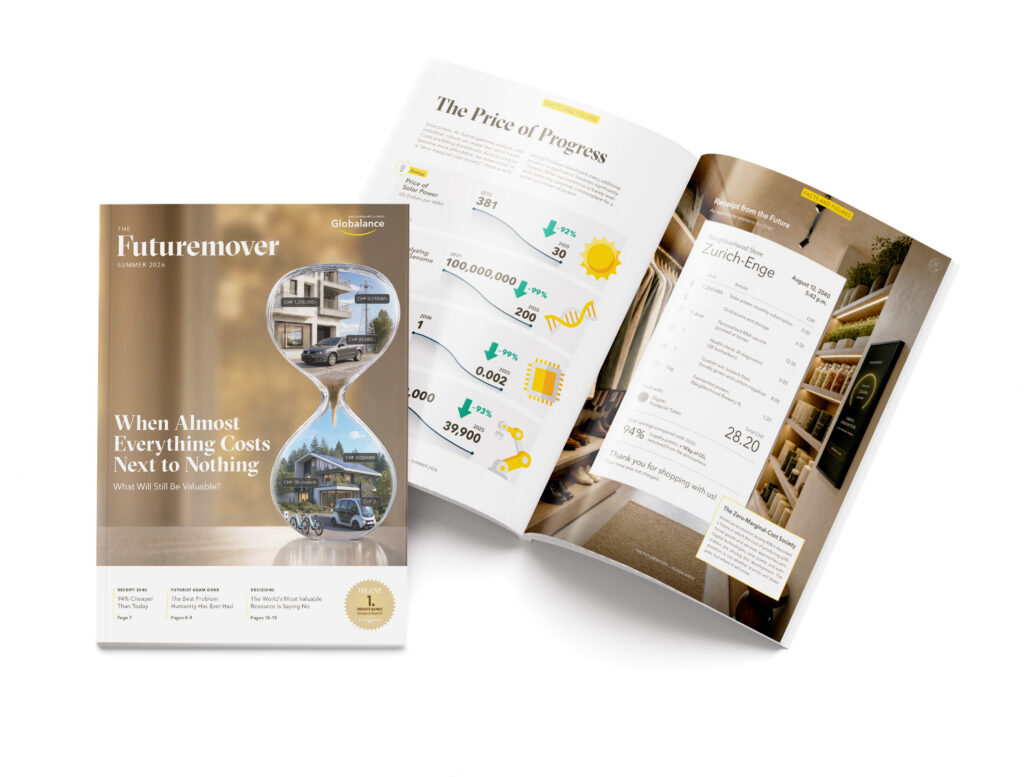
Discover the entire issue
Read more articles from our current issue: ‘When Almost Everything Costs Next to Nothing’.
Be part of the solution and stay informed with the Futuremover.
Subscribe now and shape the future!
Magazin abonnieren EN
"*" indicates required fields