News & Trends
We Can Do Without Nuclear Power
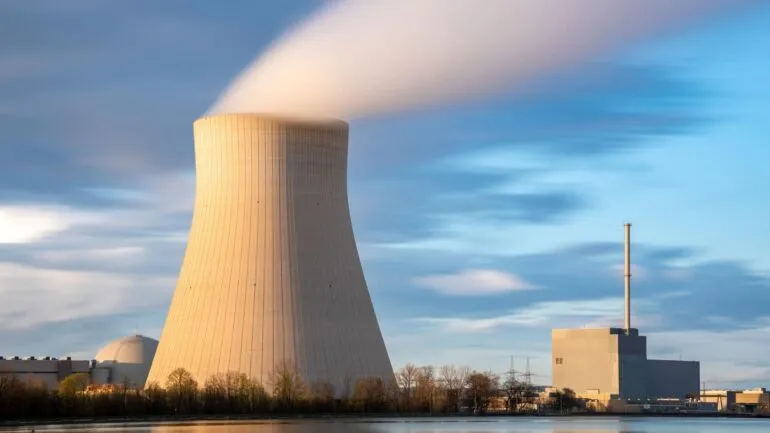
Why the facts still weigh against nuclear power from both a policy and investor perspective, despite growing geopolitical uncertainty.
WHAT THIS IS ABOUT
Nuclear power produces very few greenhouse gas emissions during operation. For years, expanding nuclear capacity has therefore been discussed as a potential contribution to climate action. In theory, new nuclear power plants could help replace coal- and gas-fired generation, which has a far greater impact on the climate. This could support the decarbonization of the power sector.
At the same time, global energy scenarios continue to make one thing clear: the main drivers of the transition are not new nuclear power plants, but renewables, power grids, storage, electrification and energy efficiency. These technologies and infrastructure are at the heart of the future energy system.
THE CONTROVERSY
Nuclear power remains a controversial topic in the global energy transition. Can energy security be maintained in the future without nuclear power plants? Should geopolitical uncertainty prompt countries to reverse, or at least reconsider, previous decisions to phase out nuclear power?
The war in the Middle East has intensified this debate. Disruptions around the Strait of Hormuz have highlighted just how vulnerable global energy flows can be. In 2025, an average of around 20 million barrels of oil and petroleum products passed through the strait every day, along with a significant share of global LNG trade. Its importance for energy security, prices and trade routes is therefore substantial.
In times of crisis, energy security becomes a higher priority. Nuclear power may become more attractive to some countries because it can provide a predictable, non-fossil domestic source of electricity and reduce dependence on imports. At the same time, nuclear power is not renewable. It relies on uranium, a finite resource whose extraction and processing create geopolitical dependencies of their own.
Other significant drawbacks include accident risks, radioactive waste and the high costs of building, financing and eventually decommissioning new nuclear power plants. It is understandable that governments facing a crisis do not want to rely on a single technology. But that does not mean nuclear power is the most compelling economic or strategic solution over the long term.
The Globalance View
We recognize that nuclear power can contribute to climate action and, in some countries, to energy security. Nevertheless, we do not believe the case for building new nuclear power plants is compelling, either economically or from the perspective of a future-oriented energy system. High and difficult-to-predict investment costs, long development timelines and unresolved risks all weigh against them. Globalance believes that a future-oriented energy system can be built without new nuclear power plants. For private investors, we therefore do not see nuclear power as a compelling long-term investment opportunity.
A Future-oriented Energy System Without Nuclear Power?
Leading international organizations consider nuclear power one of the pillars on which a climate-friendly energy system could be built over the coming decades. In the International Energy Agency’s Net Zero Emissions Scenario, global electricity generation from nuclear power roughly doubles by 2050 compared with today.
So, do climate action and energy security justify building new nuclear power plants despite the concerns traditionally associated with the technology? And if so, what role should investors play? Can we recommend investing in this technology, or even in uranium mining, to our clients?
PRO: THE CASE FOR NUCLEAR POWER
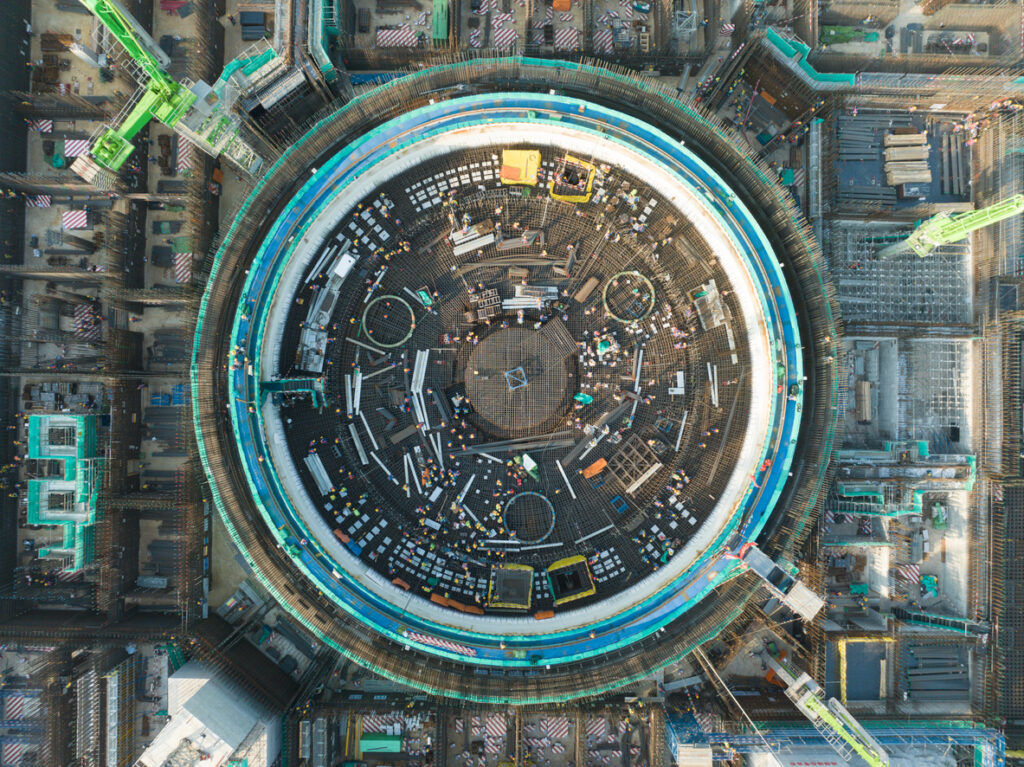
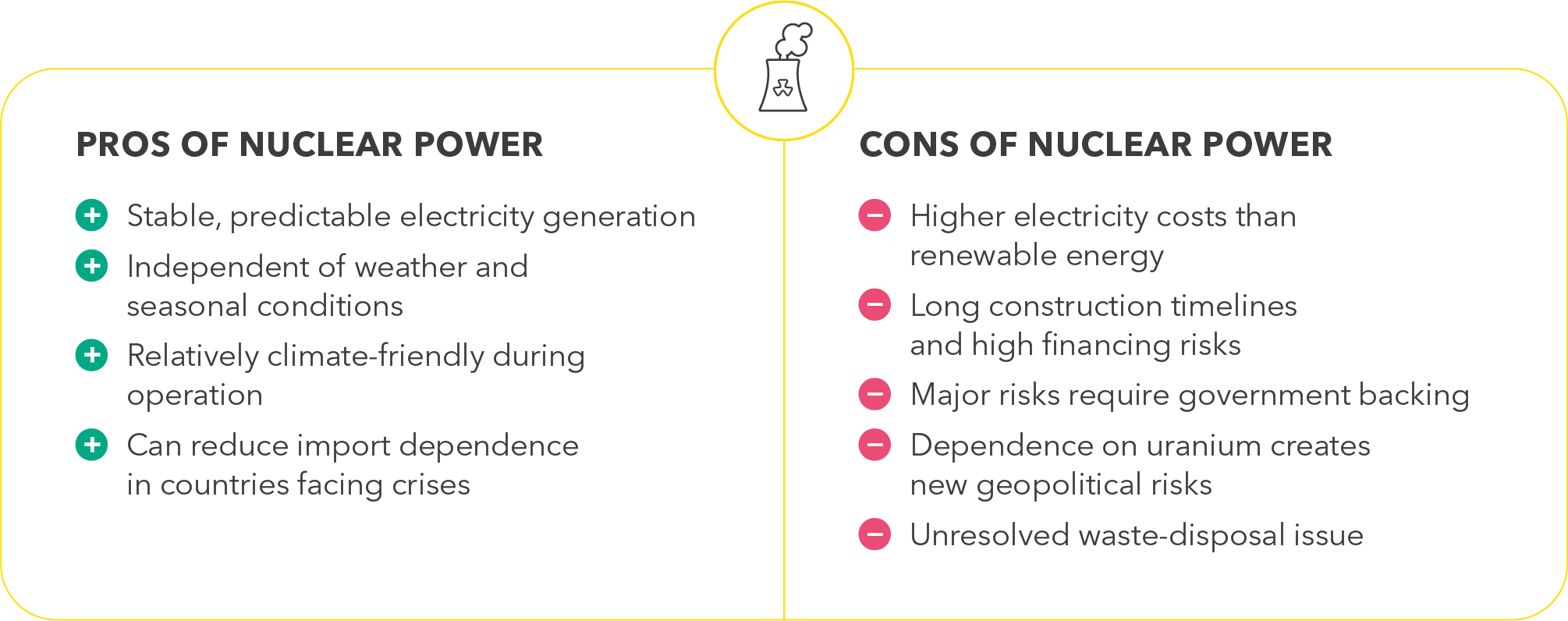
Global warming is one of the most urgent environmental challenges we face. Every kilowatt-hour of low-carbon electricity matters. In many countries, it would therefore make little sense to shut down existing nuclear power plants prematurely if they had to be replaced with fossil-fuel generation. Nuclear power also generates electricity regardless of weather conditions and can therefore help stabilize an energy system. In a world of growing geopolitical conflict, cyber risks and disruptions to trade routes, this characteristic is more attractive than it would be in more stable times. Nuclear power plants also require relatively little land compared with the amount of electricity they generate. The EU has also taken these arguments into account. Under pressure particularly from France and several Central and Eastern European countries, it has classified certain nuclear activities as “green” under strict conditions. These countries hope this will make it easier to finance new plants and operating-life extensions with private capital.
CON: THE TRUE COSTS ARE TOO HIGH
The real momentum in the energy transition is not in nuclear power, but in renewable energy and the infrastructure that supports it. The IEA describes a world in which energy security, electrification and the expansion of clean technologies must be addressed together. Renewable energy continues to set records for new capacity, while modern power systems primarily require grids, storage and flexibility. New nuclear power plants are a poor fit for this transition: they are expensive, complex and slow to build. Particularly in liberalized electricity markets, they are difficult to finance without significant government support. There are also risks that cannot be covered through conventional insurance, as well as uncertainties surrounding decommissioning and waste disposal.
The Financial Facts on Nuclear Power
Very Long Development Timelines: In advanced economies, new nuclear power plants often take many years to become operational. The IEA notes that recent projects in these markets have frequently run well over budget and behind schedule.
For the energy transition through 2030, the key challenge is not whether these projects are technically feasible, but whether they can be delivered quickly enough.
Source: IEA, Nuclear Power and Secure Energy Transitions, 2022; IEA, The Path to a New Era for Nuclear Energy, 2025
High and Uncertain Investment Costs: New nuclear power plants require substantial capital. Citing IEA estimates, the IAEA reports capital costs of around USD 8,000 to 11,000 per kW or more for recent first-of-a-kind projects in the EU, the United Kingdom and the United States. In countries with ongoing construction experience, such as China, South Korea and Russia, reported figures are closer to USD 2,500 to 5,000 per kW.
For a large nuclear power plant with a capacity of 1.2 to 1.6 GW, this translates roughly into CHF 3 to 16 billion, depending on location, financing costs, and project risk.
Source: IAEA, Climate Change and Nuclear Power 2024; IEA, Nuclear Power and Secure Energy Transitions, 2022
Cannot Be Fully Insured Privately: Major nuclear accidents can cause extremely high cross-border damage that is difficult to quantify. Liability regimes therefore limit operators’ obligations and rely on government backing.
In the United States, primary private insurance coverage amounts to around USD 500 million per site, supplemented by an industry-wide pool of more than USD 16 billion. Any additional disaster relief beyond that would have to come from the government.
Source: U.S. Nuclear Regulatory Commission, Backgrounder on Nuclear Insurance and Disaster Relief, 2025; U.S. Congressional Research Service, Price-Anderson Act, 2025
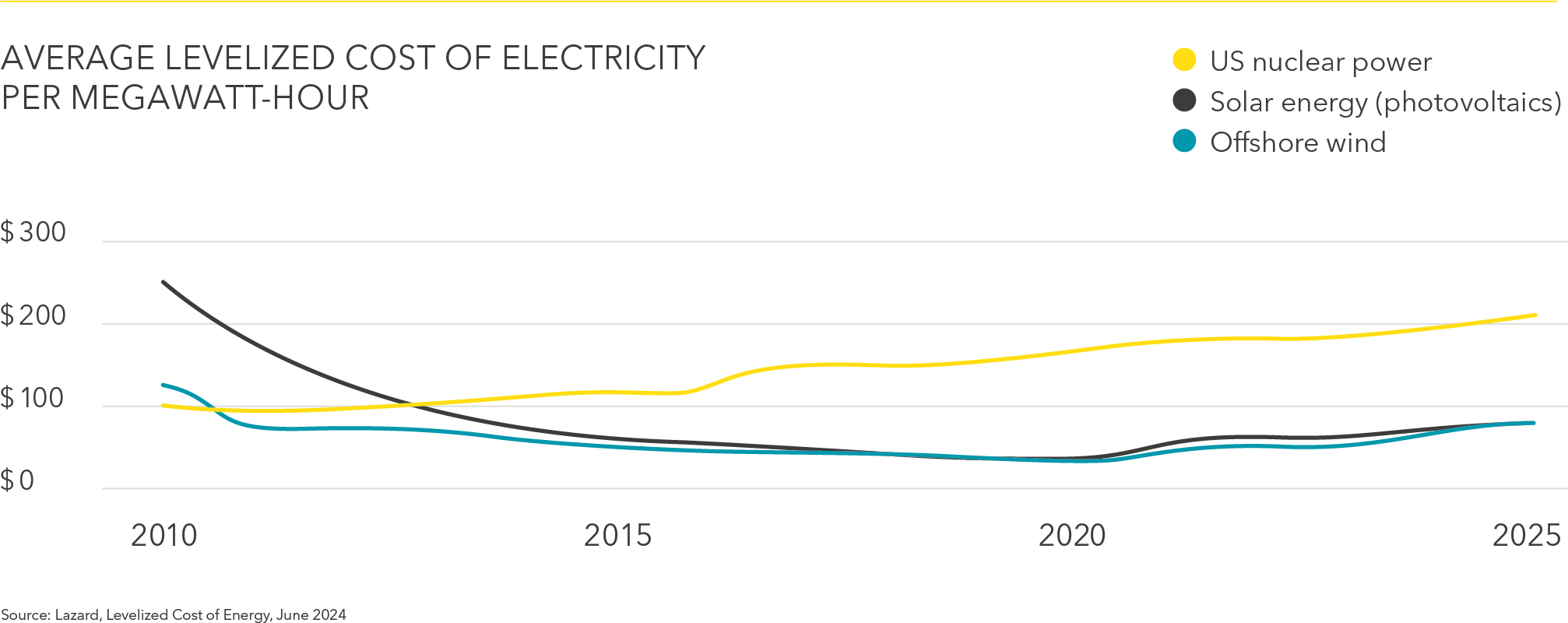
Electricity from New Nuclear Power Plants Is Expensive: Existing nuclear power plants can provide very inexpensive low-carbon electricity when their operating lives are extended. New nuclear power plants, however, are highly dependent on capital costs, construction timelines, and financing conditions.
Source: IEA/OECD-NEA, Projected Costs of Generating Electricity 2020; OECD-NEA LCOE Calculator
Renewables Are Usually Cheaper for New Capacity: IEA/OECD-NEA data show that the costs of many renewable technologies have fallen significantly. In many markets, solar PV and onshore wind are already less expensive than conventional alternatives and new nuclear power.
Source: IEA/OECD-NEA, Projected Costs of Generating Electricity 2020; OECD-NEA, 2020
Investing in Nuclear Power: What Does That Mean in Practice?
The options available to private investors seeking exposure to nuclear power are limited. Many major utility operators are state-owned, numerous manufacturers are not publicly traded, and the uranium investment universe is heavily concentrated among a small number of companies and countries.
Experience also shows that investments in nuclear operators are exposed to significant political, regulatory, and liability risks. Even growing political support for nuclear power does little to improve its risk-return profile for private investors.
For us, clean energy is far more compelling, particularly the areas that are actually driving the expansion of the future energy system: renewable energy, power grids, storage, electrification and energy efficiency. These areas offer investors more ways to participate in the energy transition while pursuing attractive long-term returns.
That is why Globalance focuses its investments on these areas. We leave nuclear power to others.
Nuclear Power Does Not Pay Off
Is nuclear power worth investing in? From today’s perspective, our answer is clear: no.
Investment opportunities for private investors are limited and involve significant political, regulatory, and financial risks. Long construction timelines, high capital costs, and heavy dependence on government policy and support add to the challenges. Even growing political support does little to change this risk-return profile.
We do not question that existing nuclear power plants can contribute to climate action and energy security in some countries. As a long-term investment, however, we see more compelling opportunities outside nuclear power.
This article is for informational purposes only and does not constitute investment advice or a recommendation.
Investment Opportunities for the Future Energy System
In our view, the investments that will matter most for the future energy system are those that create new capacity while making energy systems more efficient, flexible and resilient. For forward-looking investors, we therefore see more attractive opportunities in renewable energy, electrification, power grids, storage, and energy efficiency. These areas directly support the transformation of the energy system while offering a broader range of long-term investment opportunities. Globalance invests, for example, in Futuremover companies whose technologies and solutions are enabling this transition:
ABB – Automation and Electrification Support the Energy Transition
ABB supports the energy transition with technologies that improve energy efficiency and sustainability. The company is delivering solid revenue and earnings growth and offers an attractive dividend yield.

Prysmian – Cable Technology for Renewable Energy
Prysmian supports the expansion of renewable energy through advanced cable and connectivity technologies.
The company has a very strong order backlog and generates solid cash flows.
The Renewable Infrastructure Group – Diversified Income from Renewable Energy
The Renewable Infrastructure Group (TRIG) invests in renewable energy projects across Europe, including wind and solar farms and battery storage, helping to reduce CO2 emissions.
TRIG generates stable returns through long-term contracts and investments in a diversified portfolio of renewable energy assets.

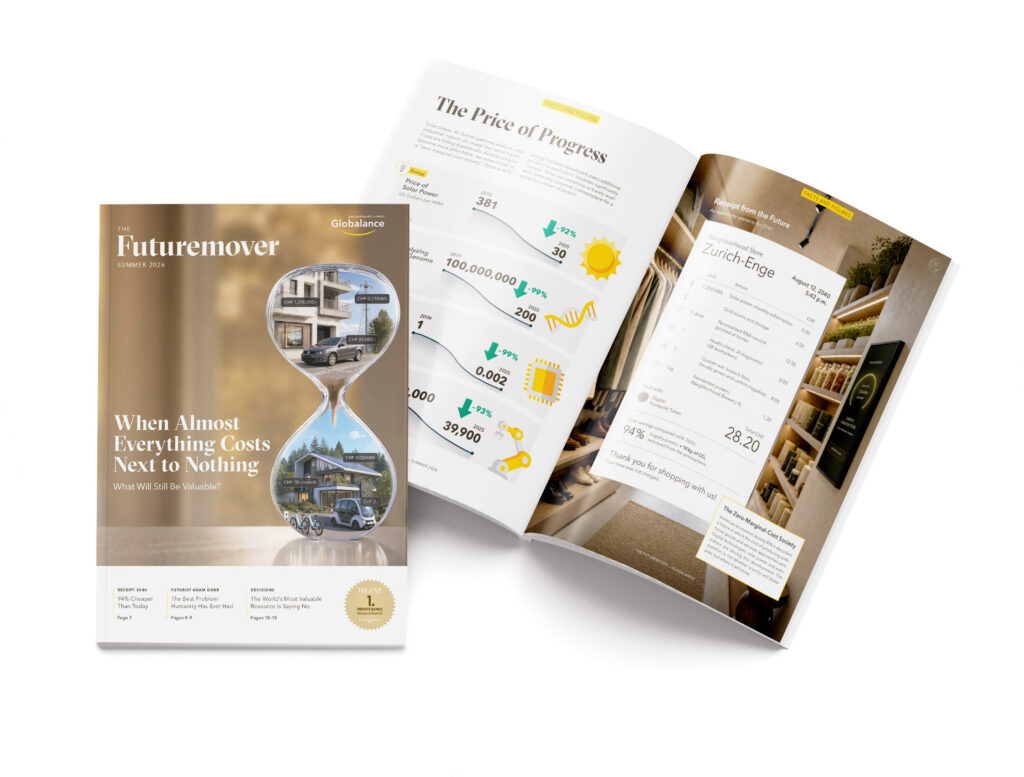
Be part of the solution and stay informed with The Futuremover.
Subscribe now and help shape the future!
Magazin abonnieren EN
"*" indicates required fields